
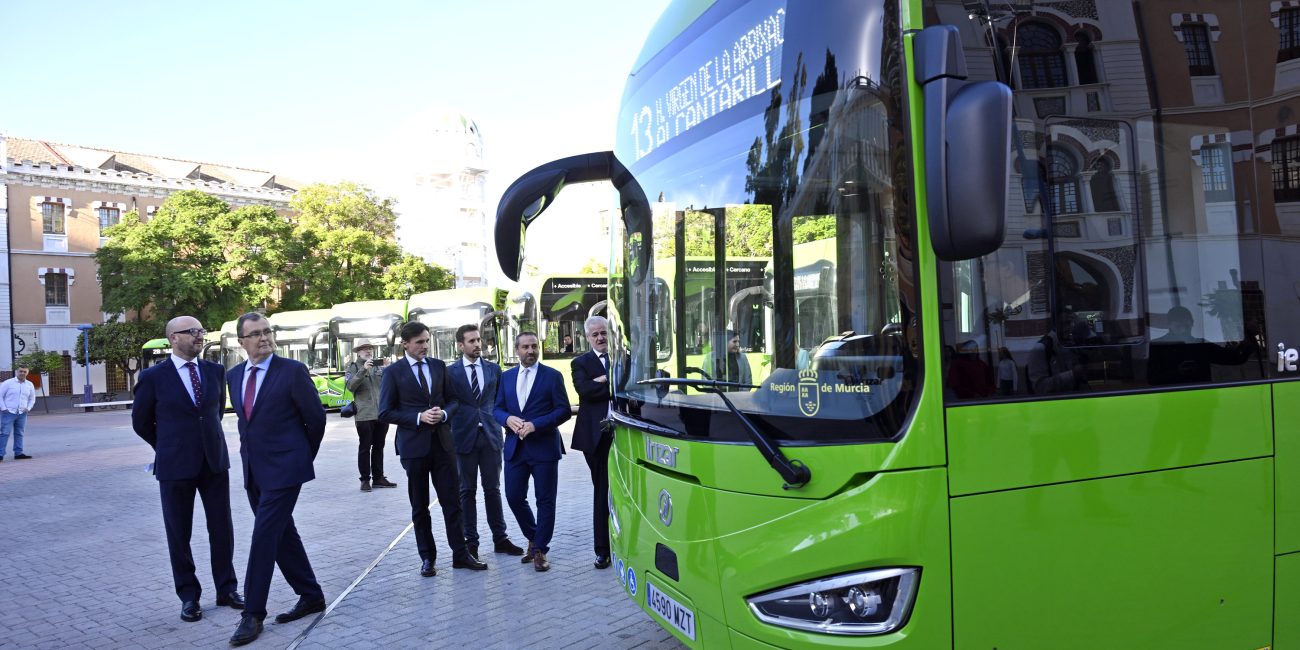
The Regional Government of Murcia gave the Murcia City Council 12 new electric buses as compensation for adding the Alcantarilla, Santomera, and Beniel bus lines to the municipal network. The Murcia municipality will run these buses as part of the regional concessions RMU-1 and RMU-2. A decree will give them the power to do so, and they will be added to the city’s urban transport network.
According to a news statement from the city, this expansion “will result in better service for users, who will enjoy modern, sustainable, and high-performance vehicles.”
José Ballesta, the mayor of Murcia, gave the cars to the people this morning in the Parade Ground of the Artillery Barracks. He was joined by Jorge García Montero, the Minister of Development and Infrastructure, and José Francisco Muñoz, the Councillor for Mobility, Economic Management, and Contracting.

The councillor said that “working together between governments is necessary to build a modern and efficient transport network.” With calm, clean, and easy-to-use public transport, Murcia will transform the way we get about in a big way.
Twelve new buses
The new Metropolitan Area will be based on the buses, which will also get 1.5 million euros a year in economic compensation for both concessions.
The cars are Class I, totally electric, and ready to serve cities and metropolitan areas. Ten of them are articulated, 12 meters long, have three entrances, an accessible ramp, 26 seats, and can hold up to 75 people. The other two are 9 meters long and include a ramp, 21 seats, and a maximum capacity of 55 passengers.
When the battery is fully charged, it can go more than 300 kilometres on the road.
Next Generation funds paid for these cars, which are worth 7.5 million euros.
After reaching an agreement with the Murcia City Council, the regional minister said that the next concessions will be RMU-3 Molina de Segura-Murcia and RMU-4 Mar Menor-Cartagena Metropolitan Area. The regional government will spend more than €3.9 million on these projects. These two concessions, along with RMU-1 and RMU-2, cover more than 60% of the people who live in the whole Region.
José Ballesta, the mayor of Murcia, said that these “12 new electric buses are the first result of this institutional agreement and the model we are promoting.” They are eco-friendly, fully electric, quiet, and efficient cars that satisfy the greatest requirements for safety, comfort, and accessibility. They are also designed to suit the needs of a modern city transport system.
Ballesta said that the new buses will give the people of Murcia a “early renewal” of the fleet while the new transport model is being put into place. This will mean better schedules, frequencies, and service to places that don’t have it now.
These buses are in addition to the tram-bus, which will connect Murcia with El Palmar, the Virgen de la Arrixaca hospital, and the Health Sciences Campus. The first vehicle for this service was shown at the Social Council meeting.
In addition to these new cars, eight more cars that are two years old will be introduced to replace older ones.
Combining the lines from nearby cities will cut down on duplication and inefficiency, making it easier for thousands of people who travel to Murcia every day to get there.
It will also greatly improve service to the municipality’s outlying regions, giving inhabitants better timetables and frequency for their daily trips.
Ballesta also talked about how the new transport model will make service better. For example, it will increase journeys between Murcia and Santomera and Beniel by 716%, from 6,727 to 54,881 per year. At the same time, trips to Alcantarilla will go up by 36%, to 75,651 each year.
All of these will lead to more frequent service, longer hours of operation, and service in regions that don’t currently have it. This change will let cars go more than 1.5 million km farther each year.
The villages along these corridors will benefit the most because the buses will run more often. On weekdays, the buses will run every 15 minutes along the route that connects Murcia and Alcantarilla, every 20 minutes along the route that connects Beniel and Santomera, and every 30 minutes along the route that connects Santomera and Alcantarilla, with the same schedules in August.
Also, the last bus to Santomera leaves at 22:20, the last bus to Beniel leaves at 23:00, and the last bus to Alcantarilla leaves at 23:50.
Also, night lines have been set up on Fridays, Saturdays, and the nights before public holidays. These lines have synchronised timetables to make it easier for people to transfer and to line up with the times that students enter and leave school.
The integrated lines will have 135,970 journeys per year, up from 68,810 now. That’s an increase of 67,160 trips on these lines alone, which is over double the service.
Lines 26, 28, 30, 31, 44, and 91 have been strengthened in the last legislature since they were the ones with the most demand or were free on certain days. This has led to record occupancy rates.

Author: Derek Appleton

Other Articles

Man found with gunshot wound in Marbella
Man remanded for kidnapping and raping a woman for a week in Alicante

No Comment! Be the first one.