
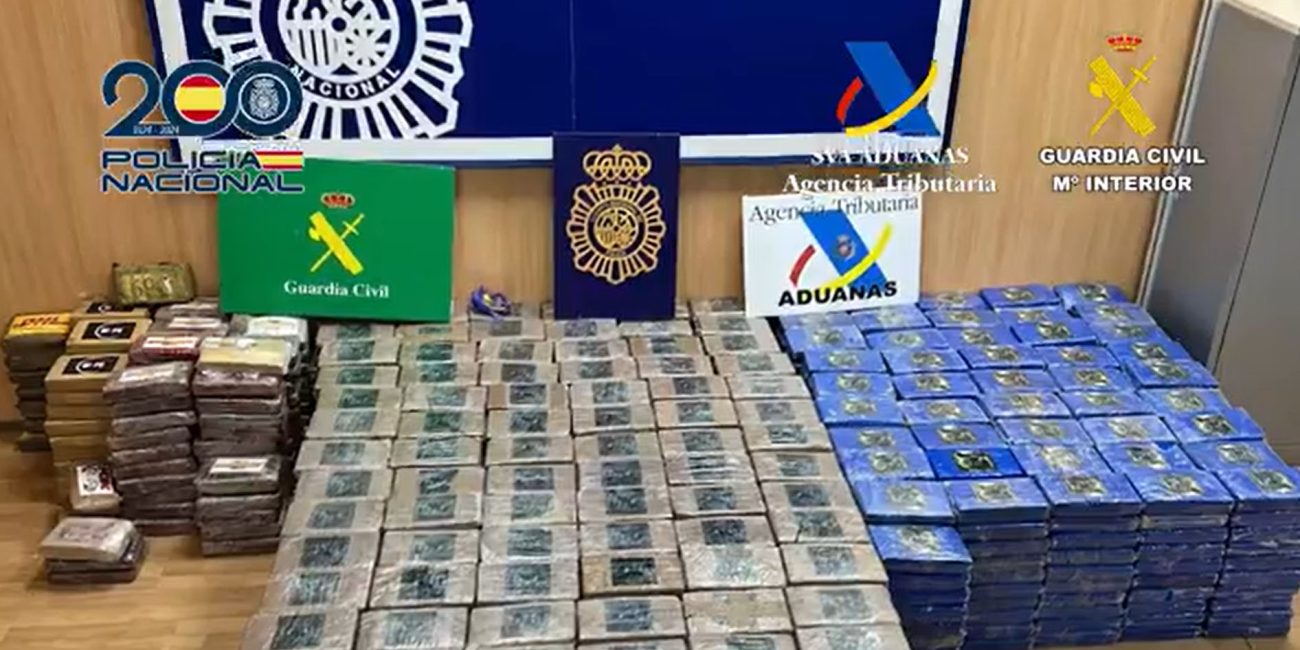
The drug mafia that runs stevedoring at the Valencian docks tried to get rid of a new shipment of cocaine that had just come in from the Ecuadorian port of Guayaquil, just two weeks after a historic blow to the large-scale drug trafficking networks that have corrupted the Port of Valencia for decades. All of their alleged leaders are in prison. A container full of tuna in sunflower oil that a business not involved in the drug trade had legitimately brought in from the Pacific to the Valencian port had at least 1,703 kilos of the substance, divided into 22 bags. The National Police took 1,013 kilos of the package at the container terminal. It was divided into 881 pills put into 13 bales. The rest of the consignment was taken from a warehouse in the Vallada industrial estate. It was 690 kilos, divided into 600 tablets hidden in 9 huge bags.
So far, three people have been arrested: two “notaries” of the Balkan Cartel—these are not academic titles, but rather the people sent by the real owners of the drugs to closely watch the operation—who were in charge of delivering the first shipment, and the driver of a rented van that was supposed to take the drugs to their owners so they could be distributed to mid-level organisations (who mix them with other drugs before putting them on the streets with the drug dealer networks of the lowest-level groups in this lucrative business).

Once again, Group V of the Drugs and Organised Crime Unit (Udyco) at the Valencia Police Headquarters is in charge of the investigation that led to the seizure of this shipment. They believe it is linked to the Port Cartel and was run by the same alleged ringleaders—those who agreed on the shipments of the stashes and those who rescued them from the terminals to deliver them to the distributors. These ringleaders have been in prison since September 26, just one week before the ship carrying this container docked at the Port of Valencia.
The medications departed Ecuador a few days before the operation
The police thought from the start that the alleged Valencian drug traffickers were waiting for a new big shipment that was already on its way between Guayaquil and Valencia when they launched the final phase of Operation Spider, which led to the arrest of 72 people between September 22nd and 24th. And they were right: the drug traffickers sent the shipment from the Ecuadorian port on September 11, eleven days before the arrests started and fifteen days before the 15th Examining Magistrate of Valencia, Vicente Ríos, sent the supposed leaders of the Valencian drug mafia to Picassent prison.
They knew this because they were watching a truck driver who was previously suspected of working with the Valencia Cartel throughout the 19-month investigation to break up the criminal group. They discovered his name when they confiscated their sixth cocaine shipment in a year and a half: On July 18th, 1,160 kilogrammes of cocaine were stopped at the port.
So, when a truck entered the port area on October 8, the National Police and the Civil Guard of the Port and Customs set up a control and surveillance system. This allowed investigators to see how the truck was diverted to a corridor of the terminal and stopped. At that point, three men who were identified as the rescuers got out of the cabin. One of them climbed up to the container that was contaminated with drugs, broke the seal, quickly took out the bags of cocaine, put a new seal on the container to hide the fact that they had broken it, and left as quickly as possible. Basically, the system is a lost hook or blind hook.
The first transfer: inside the port
After that, the truck driver went to get the container that was allotted to him and put it on the trailer bed. Then he went back to where the rescuers were waiting. These rescuers are sometimes called “spiders” or “ninjas” because they are so good at climbing and hiding. They moved a few bales and then departed the port in the truck’s cab, where the police operation began.
They followed him to the Vallada industrial complex, where they found a surveillance car that was providing security and cover. The driver told the truck driver what to do, and the truck driver backed it into a warehouse. There, the rescuers took the bales they had retrieved from the container of canned tuna that had been left at the port terminal. The transporter and the rescuers left, and an hour and a half later, a rental vehicle showed up at the same place. A woman drove it into the same warehouse.
Once inside, robbery experts from the National Police’s Special Operations Groups (GOES) took control of the truck. Udyco anti-narcotics agents then arrested the driver and one of the Albanian “notaries.” The last person got inside the truck’s cab when it got to the industrial park and stayed there, close to the drugs, until the operation was over. This “notary” probably went with the woman to the destination to make sure that everything went as planned.
Also, additional officers apprehended the other “notary” on a street that ran parallel to the first one. He was not only responsible for keeping the operation safe and trying to keep the police away, which he failed to do, but he was also giving everyone engaged very explicit directions on what, how, when, and where to do each task.
After the cargo that was going to Vallada was secured, the Police, Guardia Civil, and Customs worked together that same afternoon, October 8, to get the rest of the cargo out of the port. The cargo was in a container with cans of tuna and had been closely watched since the morning. So, they took another 881 packages of cocaine that were stashed in 13 bales, which weighed 1,013 kilos.
In 18 months, more than six tonnes
With these 1,703 extra kilos, the Puerto Cartel has now given up a total of 6,228 kilos of cocaine. Before this, there were 4,525 kilos in eight shipments. This shows how well the investigation has been able to finish the last stage of any large-scale cocaine trafficking operation by sea: safely getting the drugs from the Port to wholesalers who then sell them to small and medium-sized businesses.
As a point of reference, in 2023, the Port of Valencia lost its top spot in Spain for cocaine seizures. It went to Barcelona, and then to Algeciras a year later, in 2024. That year, 13 tonnes of cocaine were stopped at the Valencian docks, setting a new record for the entire historical record. In just over a year, the Port Cartel was able to transport approximately half of that quantity, which was more than six tonnes.

Author: Derek Appleton

Other Articles

No Comment! Be the first one.