
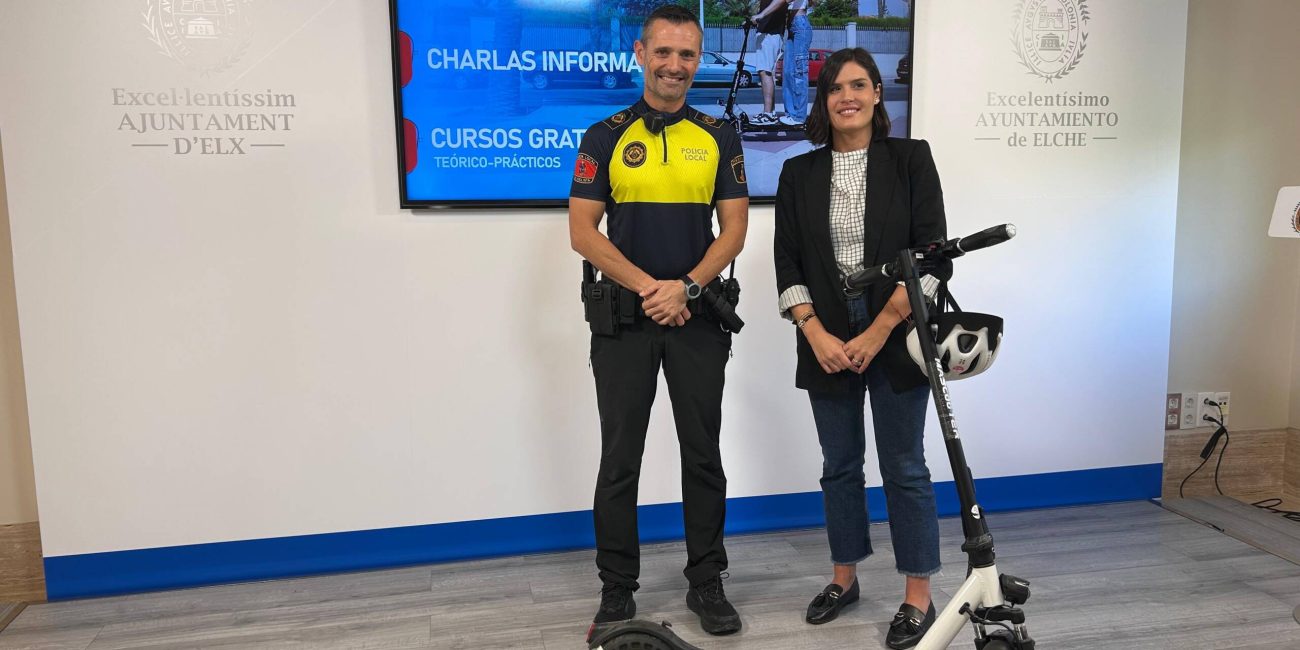
Elche City Council has given a serious warning to families and people who use personal mobility vehicles (PMVs): scooters that go faster than 25 kilometres per hour are now illegal and are called “mopeds,” which is the same name as scooters. This could lead to fines and even jail time. Chicho Fernández Bernal, the director of the Infant Traffic School, made this point clear during the presentation of the municipal road safety training campaign that he gave alongside the Councillor for Education, María Bonmatí.
Fernández says we need to pay attention to this issue: “One of the biggest problems we have is that the vehicle we bought isn’t really a VMP; if it goes faster than 25 kilometres per hour, it becomes a different technical category, L1A, and is considered a moped.” In that instance, “it falls within the criminal scope, since we are talking about an article of the Penal Code that penalises driving without a licence.”The Elche City Council has given a serious warning to families and people who use personal mobility vehicles (PMVs): scooters that go faster than 25 kilometres per hour are now illegal and are called “mopeds,” which is the same name as scooters. This could lead to fines and even jail time. Chicho Fernández Bernal, the director of the Infant Traffic School, made this point clear during the presentation of the municipal road safety training campaign that he gave alongside the Councillor for Education, María Bonmatí.

Fernández says we need to pay attention to this issue: “One of the biggest problems we have is that the vehicle we bought isn’t really a VMP; if it goes faster than 25 kilometres per hour, it becomes a different technical category, L1A, and is considered a moped.” In that instance, “it falls within the criminal scope, since we are talking about an article of the Penal Code that penalises driving without a licence.”
Fernández said, “Our educational goal is to raise awareness among these teenagers and their parents so they don’t give up on using a vehicle and instead buy the right one.” He also said that this is a top priority for the new road safety campaign being prepared by the City Council.
The Local Police have noticed a big rise in scooter use in the last few months, “which has now surpassed even bicycles,” and they have also noticed an increase in the identification of vehicles that are not personal mobility vehicles since they don’t meet the minimum technical criteria. Fernández says, “They can go as fast as 70 and 80 kilometres per hour.” He also says that more and more gadgets are being found that have been changed on purpose to go faster.
Training to learn about the new law
María Bonmatí, the City Councillor for Education, said during the launch of the awareness campaign that the goal of the City Council is to “publicise the ordinance” that will go into effect on January 1st and “guarantee road safety for all residents of Elche.”
Bonmatí said that the City Council is working on three things “in collaboration with the Local Police and the Children’s Traffic School.” The first thing is to set up seminars and workshops on Saturday mornings for teens and individuals who ride scooters. Second, schools are holding information workshops, which are mostly for teens. Lastly, there will be lectures for families, “because it’s very important to also inform adults and parents about this ordinance, what requirements they will have, and what rules we must follow.”
Today, Monday 27th October, at 7 p.m. in the Congress Centre will be the first talk for parents. Bonmatí stated, “We want everyone to come because the new rules go into effect on January 1st, and it’s everyone’s job to know about them.”
Courses in person and hands-on learning
Chicho Fernández, the head of the traffic school, said that the campaign includes in-person training classes at the Traffic School that have both a theoretical and a practical part. In the practical section, participants learn how to drive on the track and in real traffic “to teach the kids what they can and can’t do.”
Fernández stressed the necessity for self-defence by saying, “Let’s not forget how vulnerable these young people and teens are.” He also said that one of the biggest problems with traffic is that it’s hard to see: “It’s very hard to be seen,” he said. So, he suggested wearing light-colored clothes, luminous clothes, and helmet lights, especially at night.
The courses and presentations are free, and you can sign up for them by scanning a QR code on City Hall’s posters and social media. Family programs are also free until they fill up.
The new law’s basic rules
The head of the Elche Children’s Traffic School highlighted the primary regulations that would govern electric scooters in Elche:Fernández stressed the necessity for self-defence by saying, “Let’s not forget how vulnerable these young people and teens are.” He also said that one of the biggest problems with traffic is that it’s hard to see: “It’s very hard to be seen,” he said. So, he suggested wearing light-colored clothes, luminous clothes, and helmet lights, especially at night.
The courses and presentations are free, and you can sign up for them by scanning a QR code on City Hall’s posters and social media. Family programs are also free until they fill up.
The new law’s basic rules
The head of the Elche Children’s Traffic School highlighted the primary regulations that would govern electric scooters in Elche:
- Minimum age: 14 years.
- Helmet mandatory for all users.
- Individual use : passengers are not permitted.
- Civil liability insurance (between 70 and 80 euros per year).
- Certificate of technical characteristics to avoid unapproved or modified vehicles.
- Maximum speed: 25 km/h.
- It is prohibited to drive under the influence of alcohol or drugs .
- The use of headphones or mobile phones while driving is prohibited.
- Circulation is permitted on exclusive bicycle lanes , but prohibited on pavements or pedestrian areas .
Fernández said, “The ordinance is long and detailed because it had to be,” adding that Elche has been a city that really wants to make sure that everyone knows what they can and can’t do. He did, however, criticise the General Directorate of Traffic (DGT): “The DGT should have done this at the national level.” It’s helpful criticism because every city has had to make its own rules.
Awareness and involvement of citizens
Bonmatí stressed that the main goal is for “all teenagers to go to the Driver Education School and take the in-person course,” because it “teaches them how to protect themselves and others.”
Fernández said that Elche has been teaching people how to be safe on the road for 56 years through the school he runs. The current work with electric scooters is a continuation of that mission: “Know what you can and can’t do, but most importantly, protect yourself and avoid accidents.”
The City Council wants everyone to go to these training sessions and always buy certified scooters and not change them. This is to avoid fines, accidents or even crimes like driving without a licence.

Author: Derek Appleton

Other Articles

Calpe’s new cameras have solved three accidents in one month


No Comment! Be the first one.