
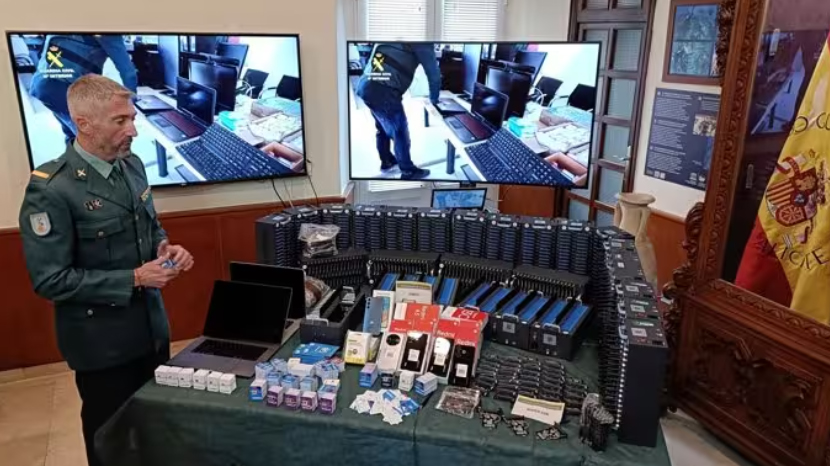
The Guardia Civil has been able to take apart a high-capacity technical structure for the first time in Spain. This structure was supposedly used to send huge messages and make fake calls, and it was open to cybercriminal networks all over the world.
A 41-year-old man has been arrested as part of the “Mosenik” operation. He is accused of being in charge of making and running this system, selling it to these groups, and then charging for the service in cryptocurrency.
The agents have taken control of a technological infrastructure that can deliver between 12 and 18 messages per minute, or 2.5 million communications each day. It is thought that the amount stolen is several million euros. The computer equipment, worth 400,000 euros, was taken in three raids in Barcelona: one at a home, one at a business, and one at a storage facility.
Several people in the province of Alicante (the first ones in the municipality of Aspe) filed complaints that led to the investigation. They said that they got calls from people pretending to be from the National Police and the Bank of Spain, who pressured them to give out their bank information and make large transfers.
The Guardia Civil says that the organisation may have targeted Russian and Ukrainian citizens living in Spain, among other victims. Some of these calls were actually made in their own languages.

400,000 euros worth of material
The agents have taken 400,000 euros worth of computers and technology, including 35 boxes of industrial SIM cards with 865 modems, 852 active SIM cards, more than 60,000 national SIM cards that can be used right away, 10,000 new SIM cards, a lot of computer devices, cash, and cryptocurrencies.
One of the things that was taken was a briefcase with a portable SIM card box that could be used anywhere with an internet connection, either through wifi or a mobile network. This made it harder to find.
The Alicante Organic Unit of Judicial Police (UOPJ), the Barcelona Technological Investigation Team of the UOPJ, and the Tarragona Citizen Security Unit have all been involved in the operation.
Unauthorised transfers
On Friday, a few members of the armed institute conducted a press conference at the Guardia Civil Command in Alicante to talk about the details of this plot. They also presented the seized material and explained how it worked.
Lieutenant José Carlos Vega, head of the Heritage Team of the UOPJ of the armed institute in Alicante, said that the scammers tricked the victims into trusting them and then used their devices to make unauthorised payments to their bank accounts.
After looking into the phone lines, the agents found a café that was a front because it had a phone shop licence to turn on those lines. They saw a Ukrainian man take boxes out of a house and putting them in a car while they were watching.
In this case, First Corporal Francisco Javier Herrero, leader of the Team of the Guardia Civil of Alicante, said that the man who was arrested and was in Spain had computer abilities.
Lieutenant Colonel Antonio Darder, who is in charge of the Judicial Police and Information, said that the person who was arrested is not the one who made those calls. Instead, he is the one who is said to have maintained the technological network that he subsequently gave to the groups.
The investigation is still open
Lieutenant Colonel Francisco Poyato, who is currently in charge of the Civil Guard Command in Alicante, said the same thing: the investigation is still underway and they are trying to find all the casualties, who “could be many.”
He also said that the precise amount of money that was supposedly stolen can’t be known yet, but detectives think it might be several million euros based on how well this technique works.
Poyato said that another line of investigation is looking into finding, identifying, and, if necessary, arresting criminal groups that may have been using this infrastructure. He also said that this is the “first time” that a technological structure like this has been taken apart in Spain and the “third” in the world.
How the system works
The Guardia Civil said that messages and calls were sent from a complex network of industrial SIM card boxes, each of which has hundreds of professional GSM modems inside.
Each modem works on its own like a cell phone and can send 12 to 18 messages per minute, which adds up to 2.5 million messages each day. The individual who was arrested was said to be the only one in charge of the network, which used roughly ten computers.
To keep them from being tracked, the sender’s phone numbers were changed often and only worked for a short time after they were activated. They bought a lot of SIM cards from different companies and activated them using fake names.
Even if a lot of people were contacted at once, investigators have established that they had already looked at the profiles of possible victims and that the messages or calls were meant for certain groups.
The person in jail is accused of being part of a criminal organisation, committing fraud, stealing someone’s identity, forging documents, damaging computers, and laundering money. The Court of Instruction Number One of Novelda (Alicante) is in charge of the investigation.
Advice for the people
Lastly, Poyato said that people should be careful when they buy things online, especially during the holiday season when Christmas sales are going on.
He stressed that “no one asks for” access codes or financial information over the phone anymore, so persons who say they are police officers or bank personnel should “always be suspicious” of calls from them. He also said that you should report a fraud as quickly as you can if you fall for it.
People can make a complaint in person at a station, but they can also do it online at http://www.sede.guardiacivil.gob.es or www.guardiacivil.es to save time.
This process can be used for any crime, including damage, theft, loss or misplacement of documents, finding documents, stealing a car, stealing from inside a car, and making false charges with a credit card or other electronic payment method.

Author: Derek Appleton

Other Articles

Calpe toughens penalties for unauthorised rubbish dumping





No Comment! Be the first one.