
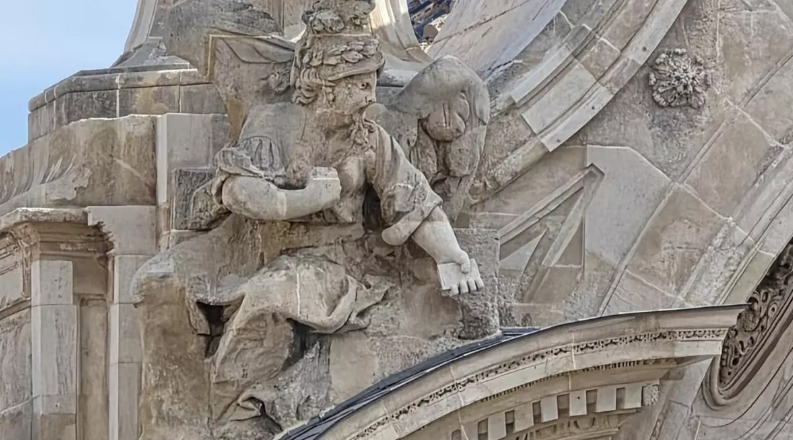
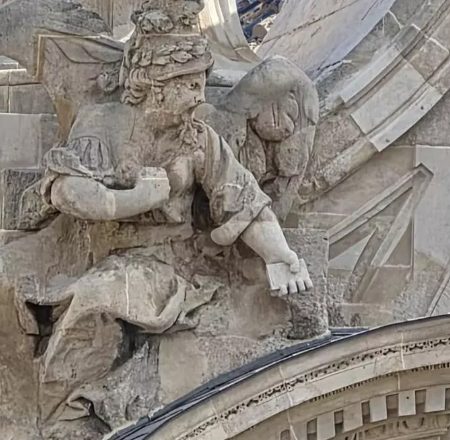
During the effort to restore the facade of Murcia Cathedral, a smartphone was put in the hand of one of the angels in the upper left side.
Councillor Jesús Pacheco said during the presentation that “this small modern touch does not change the historical value of the Cathedral in any way, but it does connect with our times and the visitor’s point of view.” Murcia keeps its history alive while also making it interesting, lively, and surprising. The municipal council said in a press release that “it is a detail designed to be discovered, to bring a smile to people’s faces, and to invite them to observe more closely what they thought they knew.”

Tonight, the night of December 3rd, the feast day of Saint Francis Xavier, the patron saint of tourism, the secret was made public. Because of this, the councillor was with official city tour guides, who would talk about this special angel when they talk about the history and renovation of the cathedral’s façade. Pacheco said, “What better day than today, the day before the celebration of the patron saint of tourism, to show off something that makes our historic centre more appealing?”
Pacheco says that these kinds of changes, where sculptors and restorers add small modern touches, can be seen in churches and cathedrals in many towns in Europe and Spain. These new figurines include modern characteristics and are meant to be creative embellishments that will, among other things, draw cultural and tourist interest. Some of the most famous examples are an old cell phone in Calahorra Cathedral, a Gremlin in Nantes, an Athletic Bilbao crest in Trujillo, an astronaut in Salamanca Cathedral, and an alien in Palencia Cathedral.
Last year, when the façade was being restored, the whole stone surface was thoroughly cleaned, including the walls, cornices, niches, and sculptural pieces. To protect the cornices from rainwater buildup and keep them from getting wet, they were fixed and zinc flashing was put in place.
The work also involved fixing up portions that had gotten worse, either with stone prostheses or lime mortar in smaller areas. It also included restoring the three principal stained-glass windows on the front of the building, which were dedicated to the Virgin of Fuensanta and Saints Peter and Paul. The new iconographic element that was revealed today was added as part of this intervention.

Author: Derek Appleton

Elche continues to improve road signage throughout the municipality


No Comment! Be the first one.