

Agamed has started building what will be the third multifunctional floodable park in the city centre of Torrevieja, in the Aguas Nuevas region. The project, which is part of the city’s Stormwater Management Plan, will be built between Avenida de las Cortes Valencianas and Avenida de La Mancha, Calle Sancho Panza and Calle Dulcinea, and across from the Adiem Foundation buildings.
There will be two phases to the project. The first phase, which costs more than €1.2 million, is currently beginning, even though work was supposed to start in September. work is expected to take nine months to finish. The second phase is intended for a later time, and right now it is being planned.

Two goals
Councillor Sandra Sánchez and Agamed’s Deputy Manager, Gemma Ruiz, told residents in a presentation before the summer that the main goal of this new park is twofold. First, it will serve as green infrastructure for the sustainable management of rainwater, with the ability to control a volume of 2,000 cubic meters. Second, it will create a new naturalised and accessible urban space for “the recreation, sport and leisure of the residents.”
Agamed created this floodable park in Torrevieja, as well as two others in the last three years: Doña Inés and Torrealmendros. Their flood control capacities of 18,000 and 12,000 cubic meters, respectively, are much higher than that of the park that is currently being built. La Hoya and Las Torretas have flood control basins that can hold more than 40,000 cubic meters of water. There are also temporary rainfall storage ditches along the CV-905 highway that were built more than ten years ago.
Agamed has been in charge of the entire water cycle in Torrevieja since 1998. The business Hidraqua, which is part of the global corporation Veolia, owns 74% of it, while the Torrevieja City Council owns 26%.
No answer even after the money spent
The Avenida de las Cortes Valencianas is one of the places that often floods during heavy rains. This is because Agamed has spent millions of euros in the last ten years building storm drains along several roads in the Casagrande industrial park to lessen the effects of these downpours. This industrial park gets water from Aguas Nuevas and the Avenida de las Cortes Valencianas by gravity. The water covers the service roads, the avenue itself, the roundabout where Avenida de Rosa Mazón meets Avenida de Delfina Viudes, and the whole stretch of Avenida de Rosa Mazón. Eventually, the water flows onto the N-332 highway and into the Doña Inés park, which can be flooded.
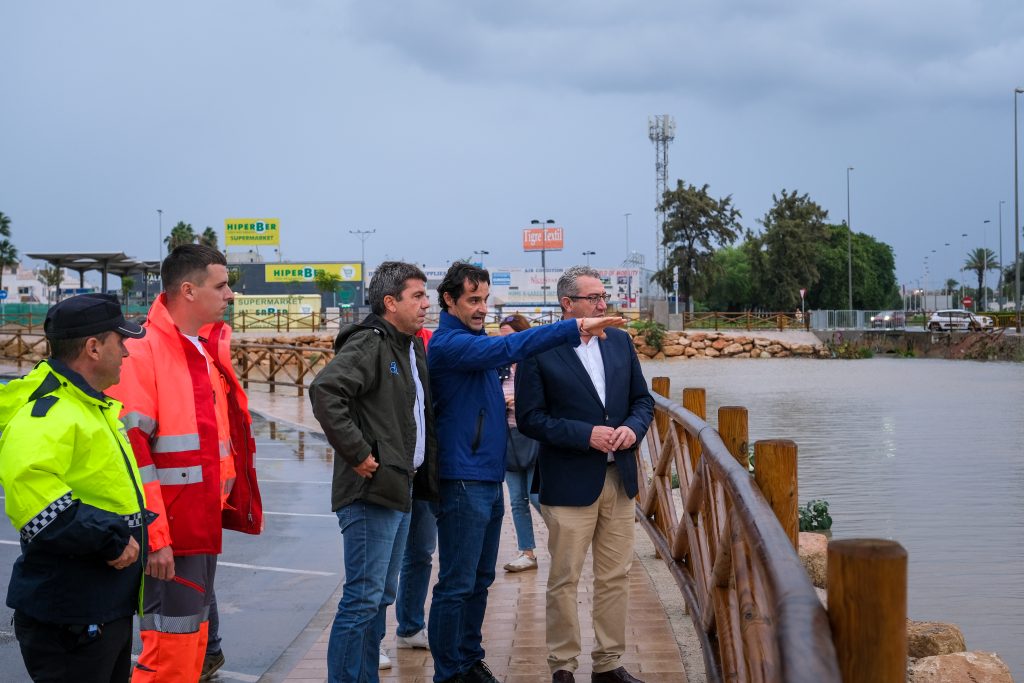
Eduardo Dolon Torrevieja Mayor and Ximo Puig, former President of the Valencian Government. Taken in October and deleted from social media accounts run by Torrevieja council as the floodparks never worked.
Design
The intervention area has been divided into two parts. One part will be for sports and leisure, with a skatepark and a skating bowl made of prefabricated concrete that will be part of the urban drainage system as well as for fun. The other part will be a “large naturalised green area” with more than 1,500 m² of rain gardens and sustainable drainage solutions (SUDS). Special care will be taken to include native plants and improve biodiversity.
The new infrastructure will be able to hold up to 2,000 m³ of rainwater, which the City Council says will be safely removed through a new pipeline that runs down Avenida de las Cortes Valencianas. According to project material, the design features “a system of interconnected basins between different retention areas that will work by gravity, which will make the drainage system more efficient and lower the risk of flooding.”
The plan also involves big changes to how easy it is to get around in cities. New pedestrian paths will connect Dulcinea Street, Sancho Panza Street, and La Mancha Avenue to existing paths on Cortes Valencianas Avenue. The pavements will be made of permeable paving and will have green spaces built into them.
Wooded
The project will involve a lot of landscaping work in the green area, where 43 trees that were transported from other green areas that were taken out in the centre of Torrevieja will be kept and 10 new trees will be put. More than 2,100 shrubs and fragrant plants, including lemon verbena, sage, santolina, rosemary, lavender, thyme, and the popular wild olive (Teucrium fruticans), will also be planted to bring the plants back to life and make the area more diverse. Finally, 250 square metres of permeable meadows will be added to the park to make it better for the environment.
In addition, an 80-metre-long plant sound protection screen will be put up next to Calle Sancho Panza. It will be made up of ornamental specimens of Cupressus sempervirens, Mediterranean cypresses, and other plants.
The project will move on to the part of Avenida Cortes Valencianas where it joins Avenida del Sur in a second phase. This area will have a new green space with play spaces for kids, callisthenics areas, and outdoor fitness equipment. This will make the park more useful and strengthen its role as a place for people to meet and be healthy.
The main goal of the project is to turn “this urban environment into a resilient space that can adapt to climate change and, at the same time, give people a place to meet, relax, and exercise in a way that doesn’t harm the environment.”
Waiting for the green zone for decades
The 4,000-square-metre green space is only a minor part of the greater area of about 40,000 square metres that was set aside for this purpose in the 1986 General Plan. Residents have been asking for a park on this site for decades. It is next to Avenida de las Cortes Valencianas, between the roundabout with the Generalitat monument and Alto de la Casilla. In recent years, the City Council has only done a little bit of work in this area, such cleaning and maintaining the scrubland. They haven’t actually made the green space itself. At the same time, the City Council wants to build a green space in Sector 25 that will be 70,000 square metres big.

Author: Derek Appleton

Other Articles


No Comment! Be the first one.