
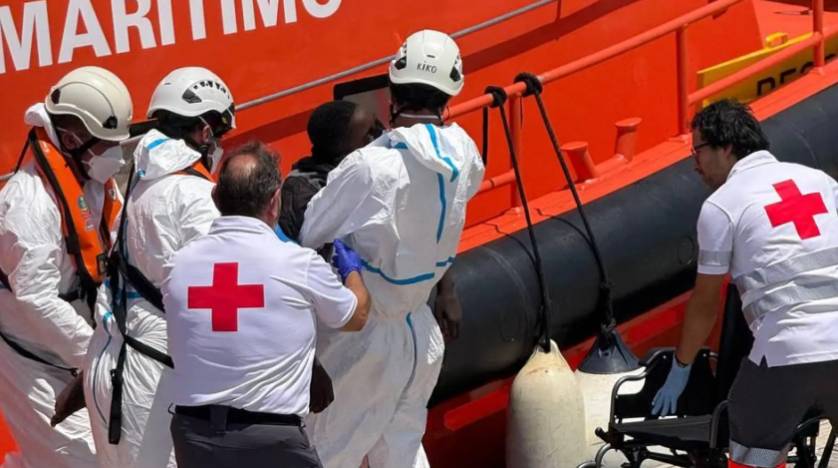
The number of migrants rescued on the Valencian coast in 2025 has fallen to 340, which is almost half of what it was in previous years and the lowest number in the last decade. Emergency services have confirmed that those who arrived were in worse health, mostly because of injuries.
The total number has gone down in recent years. In 2024, there were over twice as many, 643. The year before that, there were 776, and the years before that, there were 410, 848, 924, 673, 353, 388, 116, 26, and 84, in that order, with the last year being 2014.

The decline in numbers seems to be due to the mafias taking different ways, especially the Balearic route, where just two or three years ago no boats were stopped and now they get a lot of them.
More and more people from sub-Saharan Africa
The Red Cross, which helps these people with social and health issues when they arrive in unsafe boats, gave data that shows there have been 31 boats carrying 340 people, 321 of them are men and only 19 of whom are women. Most of them have come from North Africa, but there are also more and more people from sub-Saharan Africa.
There were 217 men, 49 teenagers, and one child. There were also 13 women over 18, two teenagers, and four girls that were saved.
According to the Red Cross, of the total for 2025, which just ended, 29 people needed to be transferred to the hospital and 116 were hurt in different ways. These numbers are much higher than in 2024, when there were only 88 injuries and 28 transfers, and in 2023, when there were 70 injuries and 16 transfers, even though the number of people saved was more than double.
Andrés Chessa, the provincial head of the Red Cross Emergency Unit in Alicante, said that individuals who want to go to Europe “are looking for new routes because the current ones, like the one in Alicante, are too crowded and have too much surveillance.”The Red Cross official highlighted that “fewer people are coming, but they are in worse condition because they are more severely affected by longer journeys from their home countries, especially sub-Saharan Africans,” because “they are the most vulnerable.”The drama is still amazing.
Chessa has said that even though the number has gone down and “it seems that society has become used to” the arrival of migrant boats, “the drama remains spectacular.” More and more often, those who are rescued say that more migrants were on the dangerous boats than died during the journey.
Many of the migrants say they have been at sea for six days and are stopped with a hypoglycemic index because their sugar levels are so low because they haven’t eaten or drunk anything. In some cases, this makes them eat jellyfish and drink seawater and even their own urine, which makes things worse.
Because the route is so dangerous, they often don’t know where in the Mediterranean they will land after a trip that has put them and often their families in debt.
Chessa said that all of these things indicate that they come “deeply traumatised.” “Each one has a very sad and shocking story behind them, and they came to this part of the Mediterranean fully aware of the risks,” she said. “They take routes that don’t always start at sea, but instead cross deserts and avoid checkpoints for a long time, sometimes a year.”

Author: Derek Appleton

Other Articles

TM plans a shopping center next to Lagoons Village, Torrevieja
Elena, the first baby born in the province of Alicante in 2026



No Comment! Be the first one.