
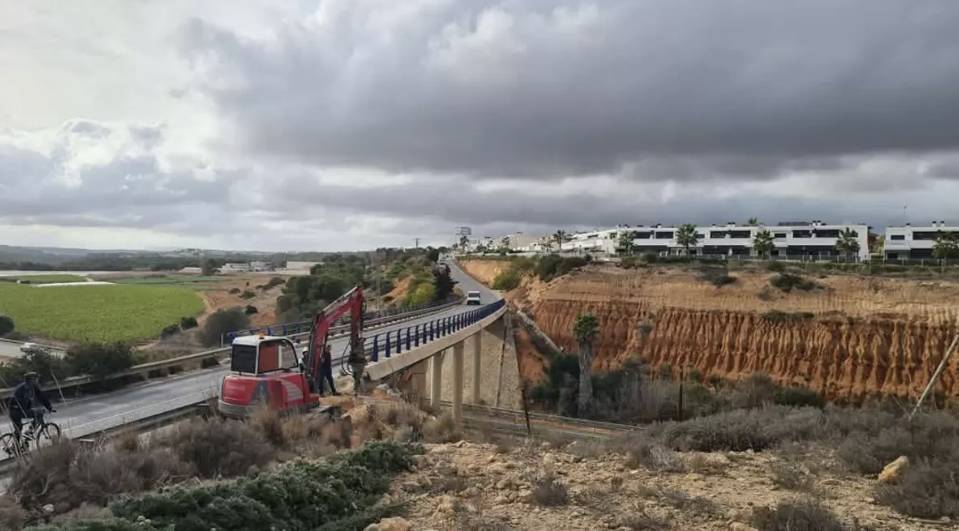
The High Court of Justice of the Valencian Community (TSJCV) has turned down an appeal from Caixabank (previously Bancaja). This means that Caixabank must give a guarantee of roughly €1.3 million to make sure that a pedestrian walkway is built on the bridge over the AP-7 motorway in Orihuela Costa. This path will link the Lomas de Cabo Roig neighbourhood to Calle Creus on the San Miguel road. For more than ten years, local residents’ groups have been calling for the completion of this long-awaited infrastructure project. They point to the continued safety and mobility issues caused by the lack of a pedestrian and bike crossing. Since 2004, the developer of the region has had to do these things.
The High Court of Justice of the Valencian Community (TSJCV) has affirmed the legitimacy of the Orihuela City Council’s decision to take the guarantee held by the urban development business. This guarantee, which was meant to help finish the project, had existed for over 20 years. The financial institution was the development company’s guarantor, which is why it challenged the decision. An earlier verdict in the Administrative Court of Elche had already confirmed that the resolution was legal.

Breach
The decision says that the financial institution’s guarantee fully covered the developer’s responsibilities, which included building the bridge over the AP-7 freeway. It also says that the developer, Urbana San Miguel SL, did not meet its responsibilities, which is why the municipality took the guarantee so that it could carry out the infrastructure project. You can take the decision to the Supreme Court.
The ruling says that the City Council followed the right legal steps to declare the guarantee expired and take it, and that the specific conditions under which the guarantee was made and the specific obligation to build the bridge “create an unavoidable responsibility that is activated in the event of non-compliance by the developer, without the need to assess guilt or specific damages beforehand.”
Neighbourhood action
Neighbourhood groups in Orihuela Costa have been asking the city to widen this bridge near the La Regia-Cabo Roig urbanisation for more than ten years. The bridge doesn’t have a pedestrian crossing, which makes traffic and mobility difficult in a densely populated area of the Orihuela coast.
The absence of infrastructural development, like in almost all incidents of tourist house developers not following the rules, goes back to the boom years of the early 2000s and the housing crisis that followed. In July 2001, Urbana San Miguel SL sent the Orihuela City Council the papers needed to develop this region. This includes building the houses and amenities and providing basic services and infrastructure to turn the land into urban plots.
In 2002, the City Council’s plenary session tentatively approved the file and gave that company the title of urban developer. Among other things, they said that “the costs of building the bridge necessary to keep the road open will be the sole responsibility of the developer in its entirety,” with a deadline of 35 months at that time.
In 2004, Urbana San Miguel SL put up a guarantee of €1,286,668 (7% of the cost of the urbanisation works) as assurance for its completion. It also got another €3,005,060 set aside for building amenities and infrastructure.
They forgot, but then the crisis arrived. The City Council agreed to the “partial transfer” of the finished works in March 2008. The corporation had finished practically all of the urbanisation project and sold or developed the plots on their own, but they hadn’t built the infrastructure they had promised to. At that time, the City Council repeated the exemption and said that the €1,286,668 guarantee would “specifically guarantee the execution of the pending works, primarily the widening of the bridge.” But the issue was put on hold and forgotten about for years, even by the municipality’s technicians and public authorities. This is similar to many other guarantees that were supposed to make sure that urbanisation projects in the coastal and pre-coastal portions of the Vega Baja region were done properly. But the people who lived there didn’t forget.
A new push
In July 2016, residents in the area put pressure on the City Council to have the developer show proof that they had started the work, especially the enlargement of the bridge. In November 2016, Urbana San Miguel SL started to make several arguments about how “impossible” it would be to do the work without getting permission from the Ministry of Public Works, which owns the road.
But on October 2, 2018, the Ministry of Public Works sent out a report that was good and binding for the building of the bridge. The City Council has to ask for this report. In May 2020, the local government told the corporation that if work didn’t start “immediately,” they would start the process of declaring the contract expired and ending the award.
So, on March 2th, 2021, the official procedure to decide who will get the programme started. In the end, the entire council opted to nullify the award and go forward with taking the €1,286,668 performance bond for making the bridge over the AP-7 freeway wider. After that, the corporation went to court and lost the first time. The guarantor bank then appealed, but the High Court of Justice of the Valencian Community (TSJCV) has also turned down that appeal. The City Council has taken over the administrative work on the project and given the contract for its development.

Author: Derek Appleton







No Comment! Be the first one.