
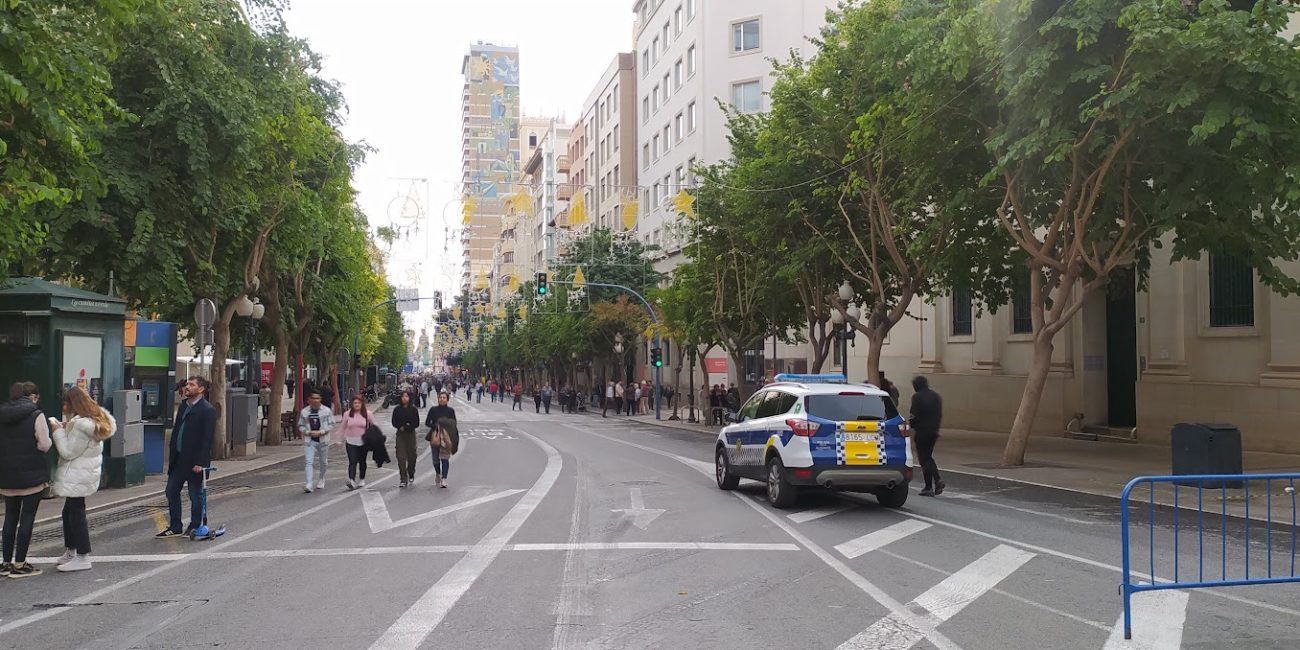
The new paid parking area in Alicante is one step closer. The Alicante City Council has started a public consultation to change the rules. Residents and community groups have 20 days to give their feedback. The need to add more parking spots for residents and workers is on the table, as is the idea of allowing two-wheeled vehicles.
This week, the Alicante City Council started a public consultation process to revise the 2012 Ordinance Regulating Restrictions on the Use of Parking on Public Roads (ORA). Luis Barcala’s administration wants to add concerns that weren’t previously known to the rules and change the hours, fees, and zones.

No more “open bar” for motorcycles
At the same time, the goal is to use the new control systems that were put in place along with the Low Emission Zone (mostly traffic cameras) to keep an eye on services. At the same time, people are working to make better use of the parking spaces that are already there, as there aren’t enough spaces set aside for residents and workers.
In this way, one of the things that the legislation wants to change is the inclusion of two-wheeled vehicles. These vehicles have not been able to use regulated parking until now, although they often cause problems with space when parked in limited locations.
The rules that will be made in the future must also cover the situation of hybrid and zero-emission automobiles. In other cities, like Madrid, they don’t have to pay to support decarbonisation. In Alicante, however, they don’t get any benefits over regulated parking.
New places for people to live
The Popular Party’s governing team has said several times that the Blue Zone might be expanded to new parts of the city with the new wording. This would mostly affect neighbourhoods around the city centre, such as San Blas and Benalúa. The announcement of the consultation period says that there are “problems of saturation and low turnover” and “an imbalance between supply and demand”.
The City Council says that “there is a lack of parking for residents and workers in several areas near the city centre, and there isn’t enough turnover to support commercial and economic activity.” The Council thinks that “to stop long-term parking in busy central areas, improve the distribution of public space, and help residents who have trouble parking” is important to solve this problem.
In this regard, the Barcala government has previously said that it wants to add up to 3,000 additional regulated positions, with 2,500 going to the orange zone (residents) and the other 500 going to the blue zone.
More penalties
The rules are being changed at a time when the city expects to make twice as much money from paid parking zones. The City Council’s revenue section shows a big rise in the parking fee. In 2025, it was €2.2 million, and in 2026, it is expected to be €4.79 million, which is a 114% rise.
In the same way, fines for traffic offences are predicted to bring in up to €8.5 million, down from €6.1 million in 2025, a 39% drop. It is also expected that the number of cars towed to the city impound lot will go up by 15%.
Contract to be given
The Popular Party also needs to renew the contract for the ORA (regulated parking system) and the city’s towing and vehicle impoundment service. They had planned to put the proposal out to bid in mid-2025, but it is still going on without a bid and with an exceptional extension to make sure it keeps going.
The Alicante City Council approved an extraordinary extension of the contract in November 2024, eleven months after it had expired and after all possible ordinary extensions had been used up. This was the fifth such extension since the contract was awarded in 2013 for an initial period of eight years, with a possible two-year extension. The Local Governing Board held an extraordinary meeting to approve the arrangement, which kept the concession going even though the last extension ended on January 25th, 2025, and there has been no competitive procedure for a new contract yet.

Author: Derek Appleton




No Comment! Be the first one.