
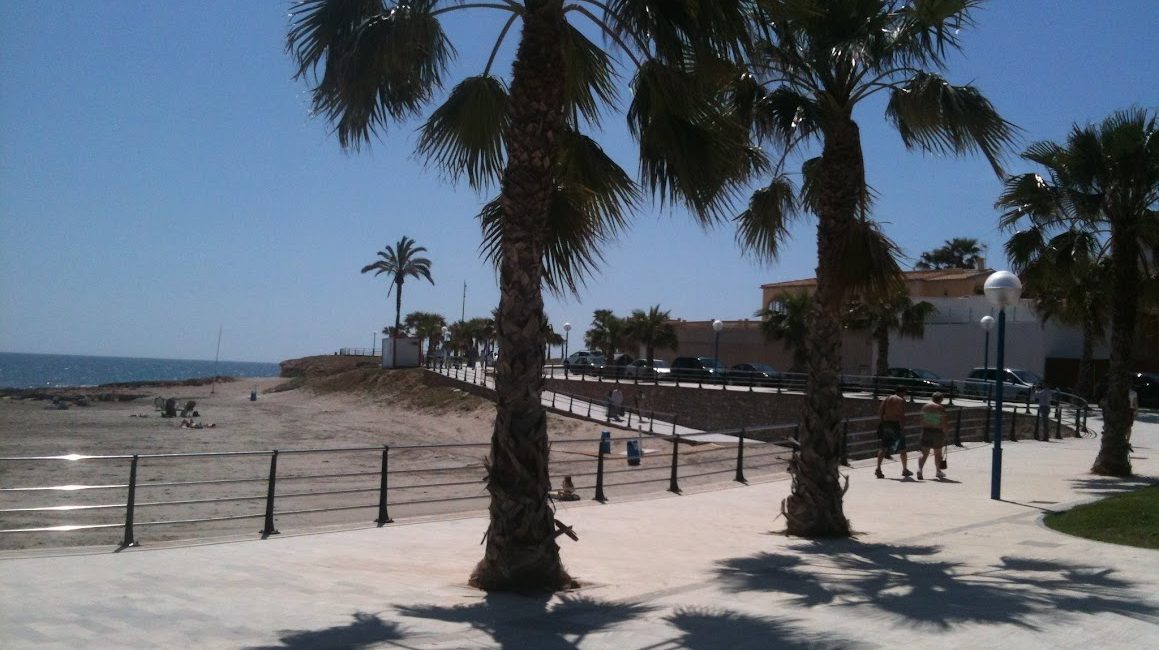
Cala La Mosca, also known as Playa Flamenca, in Orihuela, has been closed repeatedly and intermittently due to pollution for numerous summers, as have other surrounding beaches. The true source has been exposed as a result of a complaint filed by the Party for the Independence of Orihuela Costa (PIOC) with the Public Prosecutor’s Office, which, while closing the preliminary inquiry, presented a clear and full summary of the problem.
Following multiple closures in June and July, the PIOC discovered a sewage spill and informed the concessionary business -Hidraqua- and the City Council, which originally disputed the spill, according to the party.

So he went to the Civil Guard, who in this case confirmed the report and stopped the spill. Nonetheless, he reported it to the Public Prosecutor’s Office in order to determine its cause and prevent it from occurring again. According to the study, between July 17th and 25th, faecal matter was detected being discharged from a pipe about 50 centimetres in diameter in the Cala Mosca ravine, close to Calle Niagara and the Hidraqua wastewater treatment plant.
Now, thanks to the rejection of the criminal proceedings due to insufficient proof of environmental crime, it is feasible to pinpoint the exact source of the pollution that forced the beach to close due to toxicity.
The mystery has been solved: the sewage that reached the dry riverbed was discharged from an overflow pipe that was not properly connected to the storm drain system. This link, unknown to both Hidraqua (the water company) and the local municipality, resulted in wastewater running down the ravine, which flows directly into Cala La Mosca.
An unknown relationship
According to the report Hidraqua submitted to the Public Prosecutor’s Office, the water in the dry riverbed came from an overflow pipe connected to the storm drain system at the Horizonte wastewater pumping station (EBAR), which is located in a green area between Salustiana and Clementina streets. The water management business claims that neither it nor the City Council were aware of the connection of its overflow line to the storm drainage system.
The technical tests were activated in response to the PIOC’s complaint. Hidraqua confirmed the source of the leak and reported it to the pumping station’s management business as well as the Segura River Basin Authority, which halted the flow into the dry riverbed.

The Seprona report, which is incorporated into the proceedings, confirms that, as requested by the complainant, they went to the site and observed sewage discharge from a rainwater pipe on Calle Niagara and its arrival at the public waterway that flows into the beach.
Subsequent inspections indicated that the spill was stopped as a result of efforts made that day by the agencies involved.
According to the same report, the agents were informed that a breakdown led the sewage that should have gone to the treatment plant to be redirected into a rainwater conduit, which eventually flowed into the ravine.
Analytics
The Public Prosecutor’s Office also requested documents of water quality assessments conducted by the regional government in the last week of July. The results demonstrate that, while the analyses match the legal minimums, there are substantial quantities of faecal bacteria, particularly intestinal enterococci.
Furthermore, substantial quantities of Escherichia coli were discovered in the Barranco del Toro area. This coincided with considerable rains in the vicinity at the time, which explains both the pollution event and the beach’s precautionary closure.
Although the public prosecutor concludes that the events are not criminally relevant, the decree makes it clear that the source of the problem was identified and corrected and that the action taken in response to the complaint enabled the stoppage of a spill that directly affected a cove of high environmental value.
In terms of practice, the PIOC stated, “The court filing does not invalidate the seriousness of the episode nor erase an uncomfortable reality: the contamination existed, had a specific origin and only stopped after being pointed out.”
Back in 2024, toward the end of July, the beaches of Cala La Mosca and La Glea in Campoamor had to be closed due to wastewater contamination issues discovered by the regional authorities. These beaches were blocked for four days, and the Blue Flag at Cala La Mosca couldn’t be raised until 20 days later.
Blue flags
After six years of having blue flags on all eleven beaches, the municipality lost one at Cala Estaca in 2024, which it regained last summer when the distinction was removed from Playa Flamenca.
In 2023, with the current PP-Vox coalition government in charge and the newly constituted Coastal Department, the Blue Flag was nearly removed from Cala La Mosca. In fact, the Environmental and Consumer Education Association, which handles the prizes, announced their removal from this coastal area due to suspected sewage spills. However, the issue was remedied, and the flag was hoisted again shortly after, with confirmation that water quality tests revealed it to be of good quality.
Nonetheless, for more than 30 years, the municipality has topped the list of honours recognised by the Foundation for Environmental Education. This designation represents an international benchmark for environmental and tourism excellence and has become a well-known symbol for millions of users in nearly fifty countries.
To receive the Blue Flag designation, strict criteria must be followed, such as the placement of information panels about ecosystems and protected natural areas, as well as the conduct of educational events. Bathing water quality must be excellent, in compliance with European directives, and beaches must be clean, with efficient waste management and public restrooms, including facilities accessible to people with disabilities. Furthermore, secure and accessible entry points are essential, as well as first-aid supplies and qualified lifeguards.

Author: Derek Appleton

Other Articles






No Comment! Be the first one.