
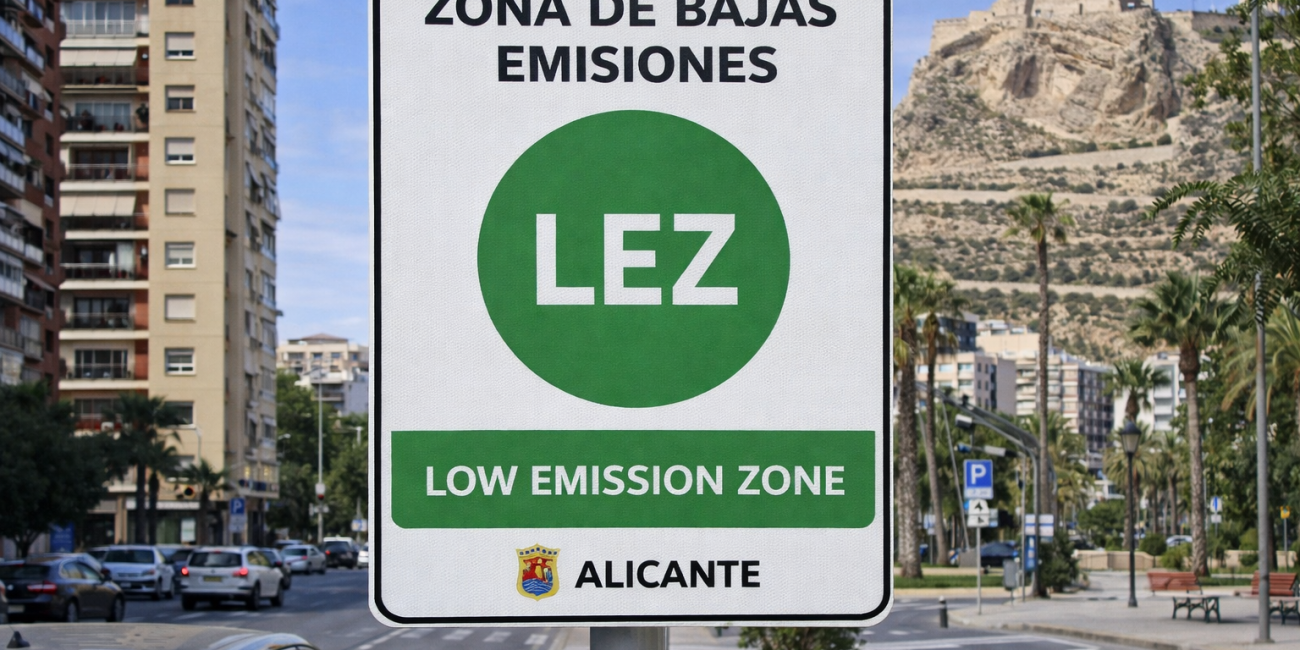
The legal examination of Alicante’s Low Emission Zone (LEZ) is now completed and awaiting judgement. The First Section of the Administrative Court of the High Court of Justice of the Valencian Community (TSJCV), which heard the environmental group Ecologistas en Acción’s appeal against the City Council’s regulations, concluded the proceedings on January 12th, following the submission of the corresponding written conclusions regarding the regulations’ validity. Only a date for the voting and ruling remains, followed by the drafting of the judgement, which will either uphold or overturn the disputed municipal rules.
The conservation group’s appeal specifically attacked the proposed implementation of the Low Emission Zone (LEZ) and its regulating code, claiming that neither proposal met the requirements imposed by the European Union (EU) and the Spanish government. According to Ecologists in Action, neither the project nor the ordinance included sufficient steps to minimise private car use, hence lowering pollution emissions into the atmosphere and improving air quality.

In this regard, their lawsuit stated that the City Council’s proposed system “does not apply the mandatory access restrictions to the Low Emission Zone (LEZ) based on the DGT environmental badges, and parking regulations, established in Royal Decree 1052/2022.” They also contended that the imposed laws “will not reduce the 164,000 tonnes of CO2 per year” targeted in the project, which would eliminate one-third of all road traffic emissions.
The truth is that the system devised by the ruling team of the People’s Party (PP), in collaboration with the Vox municipal party, does not anticipate the adoption of mobility limitations beyond those already in place for access to the streets of the Old Town since 2011. The agreement only applies to two areas: the Traditional Center and the Gran Vía axis. If environmental monitoring stations detect poor air quality or pollution levels, new restrictions may be imposed.
There would be no legal obligation imposed by the European Union (EU) to establish a Low Emission Zone (LEZ) with restrictions on private vehicle travel, accompanied by a sanctioning regime, if other alternative measures could be implemented that contribute to the same goal of improving air quality.
This position is based on the European Commission’s (EC) response to a question posed by the European Socialist parliamentary group in February 2024, which emphasises that “there is no provision in the European Climate Law under which Member States must establish low-emission zones.” The same response thus implies that there is no strict obligation to implement such regulations, though it does point out that “one of the main objectives of the European strategy for low-emission mobility is to accelerate the transition to low- and zero-emission vehicles, which will lead to a reduction in greenhouse gas emissions generated by urban transport.”
Furthermore, the same response from the EC – provided by municipal legal services to the procedure as theoretical evidence in its favour – emphasises that “the rules for vehicle access to urban areas, including low emission zones, are also aimed at reducing air pollution in urban environments and have proven to be effective in that regard,” implying that their application would be at least advisable, as reported by this newspaper.
In any case, the municipal viewpoint maintains that this response would support the City Council’s actions, claiming that “there is no obligation to establish low-emission zones” and that “when specific measures are established, they will be adopted by the member states.””In this regard, the municipal conclusions document points out that “in our case, the City Councils are responsible for establishing these zones, and provided they pursue the general goal of reducing pollution, specific or additional restrictive measures beyond those already implemented are not required if, as is the case here, the same objective can be achieved with less restrictive measures.”
System is backed by reports
As a result, the request to dismiss the move for annulment submitted by Ecologistas en Acción is being made, after further disputing the constitutionality of the mechanism used to establish the agreed-upon measures. Specifically, it states that a research was conducted on the unique situation of the city of Alicante, which included a socioeconomic analysis of the consequences of enacting the recommended measures. The city’s air quality measurements are below the “annual or daily reference limit values contained in Annex II of Royal Decree 102/2011, of January 28, concerning the improvement of air quality.”
Third, it is recognised that the regulations outlined in Alicante’s Low Emission Zone (LEZ) are appropriate and warranted. Fourth, it is stated that this regulation “not only contains restrictive measures, but also includes a series of incentives for non-polluting mobility, measures adopted by the City Council itself, regarding the modernisation and electrification of urban transport,” referring to the use of 100% electric buses or those equipped with a hybrid propulsion system to reduce carbon dioxide emissions. Furthermore, it is stated that the LEZ creates “a traffic restriction zone, limiting access to residents, service vehicles, and vehicles carrying out economic activity in the area, with authorisation in some of these cases.” Accordingly, it is emphasised that “failure to comply with these measures entails the corresponding penalties stipulated in the City Council’s traffic ordinance, as well as in the Traffic Regulations, the Road Safety Law, and the Highway Code.”
Finally, in addition to alluding to the EC’s response, it emphasises that the conservationist group’s request to repeal the current system and establish a more restrictive system would be based solely on “conjectures” and “opinions” without foundation and would not be supported by any specific study or report, as is the case with the procedure used to define the ZBE.
Ecologists in Action, on the other hand, believes that the requirements for the implementation of Low Emission Zones (LEZs) are specified by Spanish regulations, as previously published in this newspaper. Furthermore, it states that there are currently European regulations mentioning the implementation of restrictions on private vehicle use. This is one of the points outlined in Annex VIII of Directive (EU) 2024/288/EC on air quality, in the indicative list of measures for reducing air pollution, point IV, which refers to “the establishment of systems restricting urban access to vehicles, including low-emission zones and zero-emission zones.” Similarly, the conservation group claims that this reference to LEZs was also included in the previous Directive of 2008, 2008/50/EC. In any case, the High Court of Justice of the Valencian Community (TSJ) will now analyse the viewpoints offered by both parties in order to deliver a decision.

Author: Derek Appleton

Other Articles

National Police detect 30% more fake documents at Alicante airport





No Comment! Be the first one.