
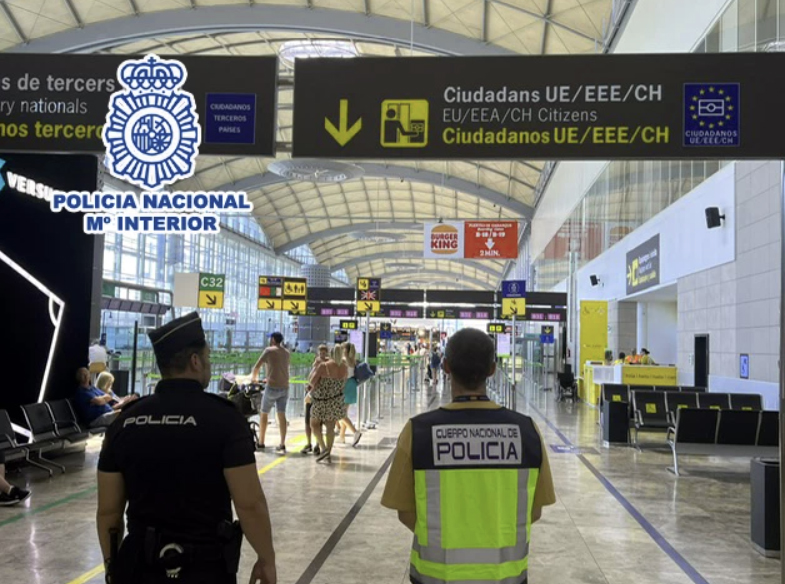
Alicante-Elche Airport’s data from recent years speaks volumes. Take a look at the data for 2025, when the terminal once again broke its own records with 19,950,394 passengers, signifying an 8.5% rise over the previous year and its third straight annual record. As a result of the high volume of activity at the airport, the proportion of counterfeit documents has increased as well. The numbers handled by National Police personnel at the El Altet Airport Border Post, which is affiliated to the Elche Police Station, provide proof of this. In 2025 alone, they seized 90 fraudulent documents, which is 30% more than the previous year, or one case every four days. However, rather than decreasing, the number of fake IDs increased in January: approximately fifteen, or one every two days. In all cases, the individuals are apprehended as they attempt to depart the province for another location. When forgeries are discovered during admission, the person is immediately returned to their place of origin.
The recent cases
There are instances of all types of incidents from the last few weeks. One is that of a 34-year-old Taiwanese guy who planned to go to Dublin. However, only at the initial visual assessment did the authorities at the checkpoint question the authenticity of his passport. Among other things, the photograph seemed to be mismatched. As a result, a subsequent investigation verified that the biographical image did not match the individual. However, the paper was genuine; only the photograph had been altered. He was arrested for document fabrication.

Even with minors
Another notable instance is that of a 47-year-old Georgian woman who sought to travel to Bristol, UK, with two minors, ages 12 and 15. All three were using fraudulent passports, as evidenced by ultraviolet light on the biographical page of the documents. The boys were not her children, but she had a notarised power of attorney from their parents that authorised the trip. She, too, was detained for document falsification, and the children were placed in the care of parents’ friends who resided in the province with their consent. Similar incidents, though not exactly analogous, include an Iranian guy with a German passport who attempted to fly to Ireland while carrying an identity card printed on a different type of paper from the original.
Alicante-Elche Airport’s recent history speaks volumes. Take a look at the data for 2025, when the terminal once again broke its own records with 19,950,394 passengers, signifying an 8.5% rise over the previous year and its third straight annual record. As a result of the high volume of activity at the airport, the proportion of counterfeit documents has increased as well. The numbers handled by National Police personnel at the El Altet Airport Border Post, which is affiliated to the Elche Police Station, provide proof of this. In 2025 alone, they seized 90 fraudulent documents, which is 30% more than the previous year, or one case every four days. However, rather than decreasing, the number of fake IDs increased in January: approximately fifteen, or one every two days. In all cases, the individuals are apprehended as they attempt to depart the province for another location. When forgeries are discovered during admission, the person is immediately returned to their place of origin.
As soon as the passengers arrived at the airport, one of the agents in charge of frontline control stepped in.
One of the agents in charge of frontline security, right after travellers arrive at the airport.
Even at the end of January, a report was received at the airport’s Border Post informing them of a theft in the terminal’s check-in area. A 45-year-old Algerian man was eventually apprehended at the bus stop and charged with theft and document forgery after presenting a false document when identified. That same day, a 31-year-old Moroccan man attempted to fly to Cologne, Germany, using a Belgian identity card that, upon closer investigation, was discovered to be fraudulent. In addition, he had an outstanding warrant from a Benidorm court for document falsification and was accused with breaking immigration law because he was in Spain unlawfully.
The Motivations
These are just a few of the circumstances that agents have recently faced. The motives for attempting to cross the border with fake documents are numerous. Agents generally have no idea what the underlying causes are, although knowing that organised crime is engaged in the majority of instances, which explains why the destination countries are frequently repeated. Furthermore, they confirmed that the most popular route is to Ireland, notably Dublin, which, while part of the EU, is not part of the Schengen Area. In fact, at certain times of the year, these locations account for 90% of the cases they handle.
Nationalities
In terms of nations, there are people from all over the world, yet they confess that there have been moments when there were a lot of citizens from Asian countries like China, South Korea, Taiwan, and Japan. Previously, many Georgians and Albanians held Greek and Belgian passports. In any case, when border checkpoints notice the same nationality repeated, they notify the Central Unit for Illegal Immigration Networks and Document Fraud (UCRIF), because these patterns frequently occur at multiple airports in Spain at the same time. This helps them to provide the appropriate warnings and determine where controls should be tightened. This is due in part to criminal organisations attempting to operate at multiple airports at the same time, in a crime that involves three distinct components: the forger, who is rarely apprehended at an airport; the smuggler, who has been arrested if they handed over the documents at the airport; and the recipient of those documents, who is always arrested for document forgery when handing over the inauthentic identification.
The hours
There are also time patterns, so it is more common to detect falsehoods early in the morning, especially in winter, because it is understood that there may be fewer controls, when the verification is always the same; or at peak times in summer, for the opposite reason, because they believe that if there is a lot of movement, it will be easier to pass by, which also does not happen, as the National Police warn.
The protocol
What stays entirely intact is the routine, as indicated by Pedro Portero, the head of the airport’s Border Post, which ensures optimum effectiveness in these situations. There are two units involved. The workers that examine documentation at border control serve as the first line of defence, making initial contact with passengers. When identity is deemed inauthentic, the first assessment raises an alarm with a red light, whether owing to the chip, photo, or biographical page, for example. Furthermore, maintaining continual communication with the airlines makes the procedure much easier, as it is typical for the corporations to report any suspicions.
An investigation
The case is then moved to a secondary level, when people are more focused on the investigation and officials perform forensic work, creating reports that are ultimately submitted to the court authorities. These documents include passports, residence permits, and visas.
The initial inspection
According to Sergio Martínez, a National Police expert in the second line of investigation, a simple visual inspection or touch can often detect a breach in security measures. To validate this, they may compare the material to other records. One of the most prevalent problems they find is the manipulation of the security feature on the biographical page, which is laser-etched in two layers. If the image does not change to a date when moved, the suspicion begins to fade.
Other clues
There are other indicators, such as documents that appear white or very polished, indicating the usage of commercial paper, which may be confirmed with UV light. A magnifying glass can also identify the absence of security elements, such as lines, details, or microtext that are present in passports but cannot be reproduced by commercial printers. This can result in the identification of a wholly fraudulent document.

Author: Derek Appleton

Other Articles
Alicante maintains that it complies with European LEZ regulations
Drug dealing point broken up in Benidorm



No Comment! Be the first one.