
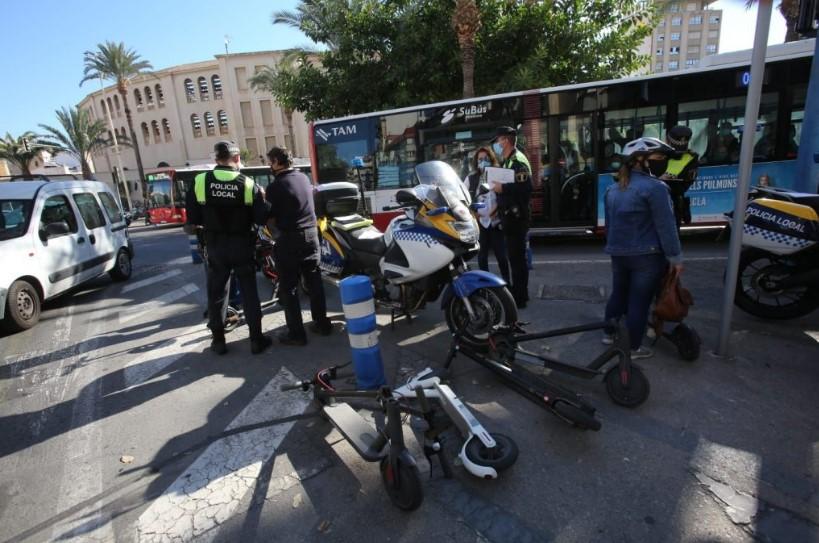
Starting on January 2nd, 2026, the City Council of Alicante will require personal mobility vehicles (PMVs) that have a circulation certificate to have civil liability insurance. This applies to PMVs that are sold after January 22nd, 2024.
People who bought electric scooters before this date can still use them until January 22, 2027, even if they aren’t certified. After that day, only certified personal mobility vehicles (PMVs) will be allowed.
Carlos de Juan, the Councillor for Urban Mobility, said, “Since these measures go into effect, the Local Police will be able to check if electric scooters have liability insurance and certification. If they do, they will be able to impound them and fine the owner.” Fines can be anywhere from €100 to €500.
The electric scooter maker gets the certificate, and it will be shown on a marking plate that must have the following information in a unique, permanent, legible factory marking, be easy to see, and not be able to be used on another vehicle: maximum speed, serial number or identification, certificate number, year of manufacture, make and model, as the council said in a statement.
Electric scooters must come with a circulation certificate. This certificate must be attached to the scooter’s structure with a metal plate so that it can be properly checked. They also need to be registered with the Directorate General of Traffic (DGT) vehicle registry.
The municipal council made it clear that everyone who owns a light personal vehicle that meets the legal conditions for circulation “will be required to subscribe to and maintain in force a civil liability insurance policy.”
The Alicante council has said that “the minimum amounts of mandatory insurance coverage for each vehicle owned by the owner will be 6,450,000 euros per incident for personal injury, no matter how many victims there are, and 1,300,000 euros per incident for property damage.”

Exceptional CERTIFICATION procedure: If you own a scooter that isn’t certified, you should contact the manufacturer to ask for homologation or start the exceptional certification procedure for a Personal Mobility Vehicle (PMV) that isn’t certified. The owner can ask for this process to be done by an authorised laboratory. They must provide the PMV and any technical material that is accessible, such as the shortened technical specifications sheet and user manual, so that the tests can be done. In this situation, you don’t have to register with the DGT (Spanish Directorate General of Traffic) as a registered manufacturer or authorised representative.
For the purposes of mandatory civil liability insurance, light personal vehicles are defined as vehicles that travel on the ground using one or more wheels, have a single seat, and are powered exclusively by electric motors that can provide the vehicle with a maximum manufacturing speed of between six and 25 kilometres per hour (km/h) if its weight is less than 25 kilos, or a maximum manufacturing speed of between six and 14 km/h if its weight is greater than 25 kilos. They can only have a seat or saddle if they have a self-balancing system.
Light personal vehicles do not include vehicles made and designed for use only by the Armed Forces, motorised vehicles or mobility aids meant only for people with disabilities or limited mobility, or cycles or pedal-assisted bicycles with an extra electric motor that has a maximum continuous rated power of less than or equal to 250 watts (w) and whose power decreases gradually and stops completely before the vehicle reaches 25 km/h if the cyclist stops pedalling.
The Alicante City Council, on the other hand, says that it has started the process of updating the rules for people who use public transport in the city by opening a public consultation for 20 working days. This will allow people to give their opinions until December 5th, “following what is established in the common administrative procedure of public administrations.”
This rule is from 1997, and one of the goals of the proposed update is “to fix mistakes in how users’ rights and responsibilities are defined, especially for people with limited mobility; to fill in the legal gaps in how personal mobility vehicles are regulated in urban public transport; to make the rule more in line with current accessibility laws”; and, among other things, “to update the punishment system.”
The Mobility Department also thinks it needs to change because it needs to “adapt it to laws about transportation, accessibility, and data protection, as well as to the new needs of users and technological advancements in the field.”
It should also be changed “in terms of the rules for personal mobility vehicles, how to make sure that people with limited mobility can get around, and how to protect users’ rights.”
The goals of this urban bus user regulation are to “guarantee the safety, accessibility, and quality of the urban public transport service, adapt the regulations to current laws on transport, accessibility, and data protection, clearly define the rights and duties of users, especially those with limited mobility, and regulate the use of personal mobility vehicles in public transport.”
Citizens, organisations, and associations may express their opinions on the issues presented by submitting a general application at the general registry of the Alicante City Council, at the Comprehensive Citizen Service (SAIC) offices on Cervantes, Portugal, and Pino Santo streets, or via the electronic headquarters.

Author: Derek Appleton
Discover more from Costa Blanca Daily
Subscribe to get the latest posts sent to your email.

Other Articles

Elderly man drives 17 kms in wrong direction on AP-7 Torrevieja



No Comment! Be the first one.