
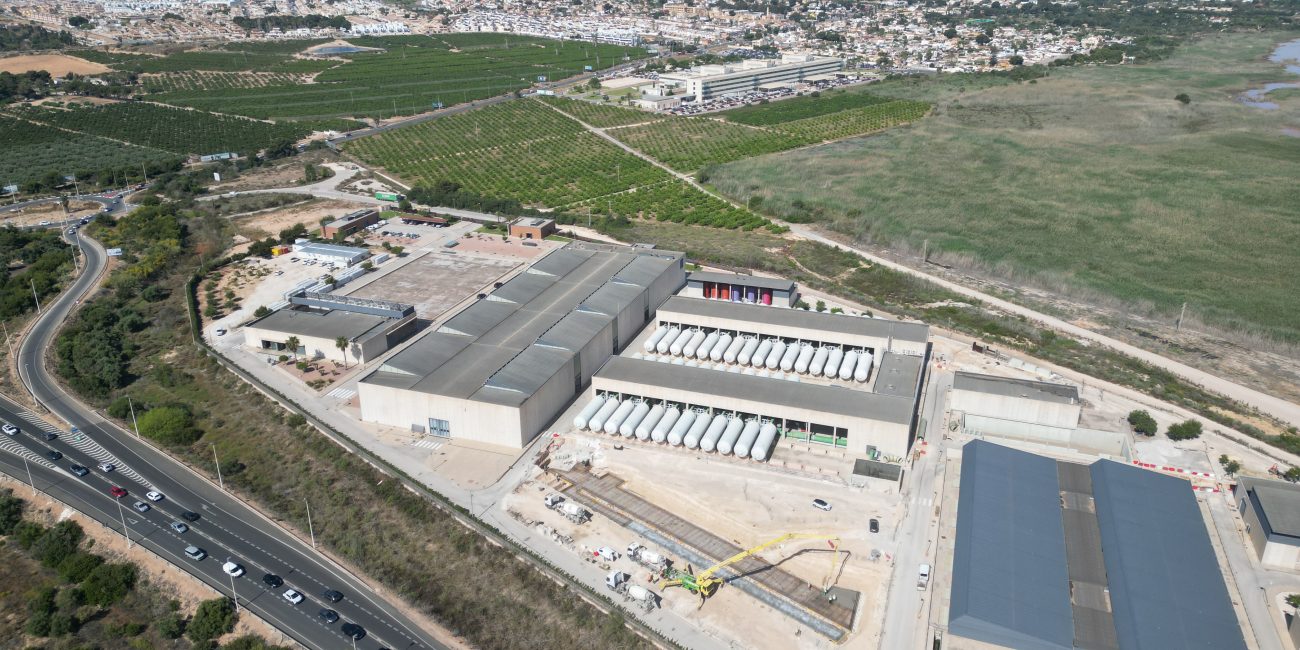
The municipalities in the central and southern regions of the province that rely on the Taibilla Canal Consortium (MCT) for their water supply will receive 42.1% of their total water supply this year (2026) from desalinated water. These comprise about thirty towns, including Alicante, Elche, Torrevieja, Orihuela, Crevillent, Santa Pola, Pilar de la Horadada, Guardamar del Segura, Rojales, Almoradí, and Callosa de Segura. In comparison to water transferred from the Tagus River and the resources of the Segura River basin, desalination has grown in importance during the past 20 years.
Predictions
Desalinated water supplies for houses have just caught up to transfers from the Tagus-Segura Aqueduct. The difference between the percentage of water supplied from this source and that received from the transfer has been gradually increasing in favour of the former since reports from the Mancomunidad (Association of Municipalities) stated that seawater production would take over as the main source by 2024.

The MCT’s projections for 2026 show a stronger trend, emphasising the reliance on this limitless resource that also necessitates a large energy investment. It’s not that there is less water being transferred for drinking. In recent years, it has stayed constant at 90 to 100 cubic hectometres each year. The demand has shifted, and more desalinated water is being produced to meet it.
The year of hydrology
Therefore, for the hydrological year 2025–2026, the MCT predicts a total output of little more than 231 hm³ for all the towns it feeds, including thirty in Alicante, forty in the Region of Murcia, and three more in the province of Albacete.
According to the most recent report from the MCT board of directors, desalinated water production will be strategically important with this demand estimate. It will account for 42.1% of total resources with a combined 97.89 hm³ (33.24 hm³ from Acuamed in Torrevieja and Mutxamel, and 64.65 hm³ produced at the MCT desalination plants in San Pedro del Pinatar and the Agua Amarga plants in Alicante). This dedication to desalination shows the increasing significance of this technology in Alicante’s water management and is a 3.1% increase over the current year.
Desalination is the most dependable and predictable resource in a climate change scenario that increases the variability of traditional rainfall, even though contributions from the Taibilla River will stay steady at 42.49 hm³, or 18% of the supply, and those from the Tagus-Segura transfer will slightly decrease to 91.18 hm³, or 39% of the total.
2025 Balance
The Taibilla Canals Association’s water resources data for the hydrological year 2024–2025 show a total production of 229.67 hm³, which is 3.32% more than the previous year. With 383.5 l/m² of rainfall as opposed to 187.4 l/m² in the previous hydrological year, this rise is the result of ample rainfall.
Desalinated water was the primary water source for the MCT in 2025, accounting for 41.3% of the total production (94.80 hm³). The Tagus-Segura transfer came in second (40.3%) with 92.65 hm³, and the Taibilla River came in third (18.3%) with 41.97 hm³. Acuamed’s desalination plants contributed 29.35 hm³, and the MCT-directly controlled units contributed 65.45 hm³.
Based on these numbers, the organisation has stepped up its efforts in desalination infrastructure, with notable advancements at the San Pedro del Pinatar facility and the Alicante desalination plant, where a solar plant is being built and another is planned. This plan is a component of its dedication to a sustainable water model that will ensure that over 3 million people have access to water in the upcoming decades.

Author: Derek Appleton

Other Articles

Authorities are investigating second shooting in Málaga
Man rescued after a paragliding accident on the hillside in Calpe




No Comment! Be the first one.