
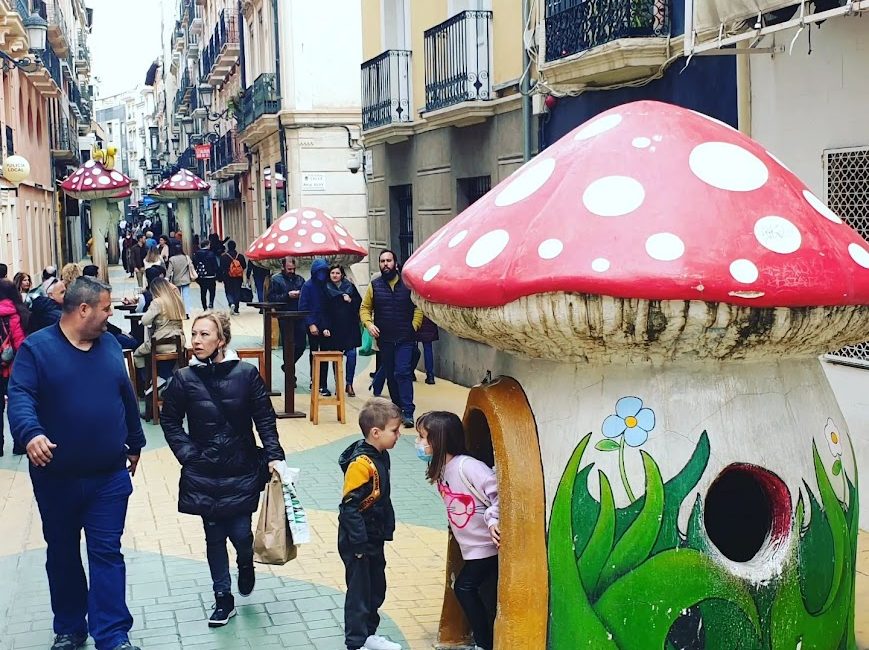
Calle San Francisco in Alicante, also called “Las Setas” (The Mushrooms), is a place of uncertainty because of impending renovations. According to the bidding criteria, the project, which has already been awarded and could start at any time, is anticipated to take three months to complete. Because of this, local companies, who had asked that the project start after Christmas, are concerned that if it doesn’t start right away, it will disrupt Holy Week.
“During Holy Week, it’s important that the mushrooms are there because of their tourist appeal; people want to come to the city centre and see the streets of Alicante. But without the mushrooms… it’s not Alicante.” Cristian Yáñez, who works at one of the street-side restaurants, acknowledges the need for restoration but expresses his worry that the work may interfere with the approaching holiday season. Due to their popularity among tourists, it is crucial that the mushrooms be available during Holy Week.

“We went to a meeting in mid-December and they didn’t clarify anything because they didn’t know when it was going to start,” says Noelia Ñeco, the owner of one of the San Francisco-based businesses, who also bemoans the lack of information. Concerned about how long the project will take, the business owner says, “We don’t know if it will coincide with Easter week.” Since they were unsure of the start time, they failed to provide us with any clarification when we attended a meeting in mid-December.
In the same way, Paula Romero, who has run a company in the neighbourhood for 16 years, notes that “the work done on the street affects the entire surrounding area,” not just the Mushroom Street location. Because there is a lot of cleaning to be done, we have been waiting a long time for it to be revitalised. We must take care of it because it’s a crucial spot in Alicante,” she continues. Romero thinks that if the improvements are finished by the end of March, “it will be good and better than doing it in the summer.” He hopes “that the renovations will be done as well and as quickly as possible.”Since there is a lot of cleaning to be done, we have been waiting a long time for them to bring it back to life.
The renovation project was granted in mid-December after being placed out to bid on October 15, 2025, and it was ultimately formalised this week on January 13th. The City Council has not yet stated the exact start date of the construction, but they have stated that it “will be soon.”

Specifics of the project
According to the specifications, “the season in which the work is carried out and the holidays that affect it are important conditions for the choice of the construction procedure,” and because of the “tourist, commercial, and restaurant appeal” that Calle San Francisco generates, the work is scheduled to take place “between Christmas and Easter.”
A total of 220 metres will be impacted by the construction, which will be split into three sections: the first will run between Jerusalem Street and the area next to Plaza Calvo Sotelo; the second will run up to Calle Navas; and the third will run up to Calle Castaños. The traffic cones will first be disassembled and repaired in a workshop. In order to create pedestrian access on both sides as the work is being done, the roadway will simultaneously be split into three sections by fencing: sidewalk, centre and sidewalk. In order to facilitate access, ramps will also be erected.
Its slow decline and the removal of the kids’ play equipment in 2024 created a sense of abandonment after it had become one of the city’s most photographed locations. With a budget of €111,150, the Alicante City Council has now approved a rehabilitation project that attempts to bring it back to its former splendour.
In return for the Vox party’s financial help, the local government of Luis Barcala signed an additional agreement that includes these projects. The future Juan XXIII police station was built as part of a package of actions for several metropolitan districts that included the project.
The street’s past
Before Calle San Francisco was dubbed “Mushroom Street,” it had a lengthy history in the city. As part of a larger initiative to make the historic centre more “European,” it was pedestrianised in the late 1980s. With the intention of “revitalising pedestrian traffic” following years of decline, cars were permitted to return to the road thirteen years later.
In order to revitalise the street, the concept of installing burning monuments in the shape of mushrooms finally emerged in 2013. Despite being viewed by many as a dangerous experiment, the project permanently altered the history of the street.

Author: Derek Appleton

Other Articles
Truck driver jailed for a year for stealing 12.5 tons of chocolate
Two die in separate choking incidents



No Comment! Be the first one.