
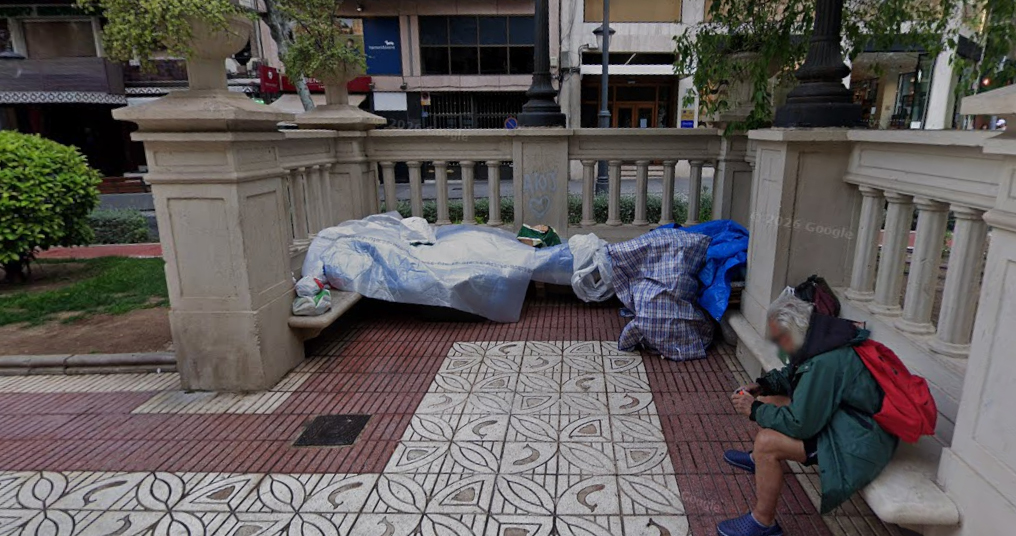
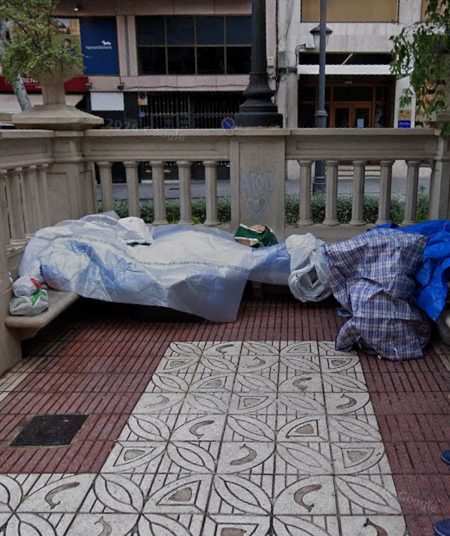
The unoccupied bench on Doctor Gadea Avenue was tough to miss yesterday, Tuesday February 9th. Where cardboard boxes, tarpaulins, and an impressive collection of books had piled up for years, only evidence of a quick cleanup and a police presence remained. Max Jimeno, the “book man,” died during the night. He was 80 years old and had been living on the streets in Alicante for almost six years.
The word immediately spread among neighbours and nearby business owners, who had become accustomed to seeing him every day on the same bench that had become his home. His death has caused great sorrow in a community that considered him a member of the neighbourhood.

This tragedy comes against the backdrop of rising homelessness in Alicante and the city’s persistent housing problem. This position is compounded by rising rents and recent issues, such as the distribution of public housing in the Les Naus complex. Max’s experience once again demonstrates a structural issue that goes far beyond a single individual.
A library as a residence
Max Jimeno had been sleeping on Doctor Gadea Street for years, protected by the promenade’s balustrade and, depending on the time of day, by the shadow of a tree. He spent his evenings and the majority of his days there, surrounded by books. No one knew exactly how many volumes he had, but they easily exceeded a hundred. He retrieved them from the bins, confident they still had value in an era where, as he put it, “everything is read on a mobile phone.”
Max, with grey hair, recently said that his pension was insufficient to cover the expense of a bed and food. That was what drove him to the streets. Despite his position, he clung to the belief that his reality would change. “I trust that this situation can be resolved, because the street isn’t a place to stay forever,” Jimeno said in September.
Another resident of Doctor Gadea
Max was a familiar face to many who worked or lived on the avenue. Shirley Baptista, a shop assistant at a nearby store, recalls how, when they arrived in the morning and saw the funeral director, “We imagined what had happened.” “He was always there, he was just another neighbour, a very quiet man, he didn’t bother anyone,” Baptista recalls. This shop clerk recalls that numerous neighbours and shop employees assisted him with food, emphasising that “he was always engrossed in his books, always reading.”
Gloria García, a shop assistant, recalls Max stopping by occasionally to enquire about shoe availability. “People would give him clothes, and when we could, we’d give him shoes,” Garcia says. They were concerned on Tuesday when they discovered that his possessions were missing and that there was a police presence. “It’s a shame; he was part of the neighbourhood, everyone knew him, he was always walking around,” she recalls, while continuing to state that “he was a good man.”
Reme Martín, like her, emphasises a long-term bond. “That bench in Gadea was his home, and we had grown accustomed to seeing him there every day,” Marten says. “All the neighbours and shopkeepers in the area looked after him,” she says, admitting that when they noticed he wasn’t there and municipal services arrived, “we feared the worst.”
Rocío, another shop assistant in the area, agreed that Max’s absence was the first thing they noticed as peculiar. “We thought it was strange this morning when we didn’t see anything at the bank,” Rocío remarked. “He was always with his books; he was practically a neighbour.”
Max may be gone, but his image remains on Google Street View.

Author: Derek Appleton

Other Articles
Cirque du Soleil will remain in Alicante until 2028


No Comment! Be the first one.