
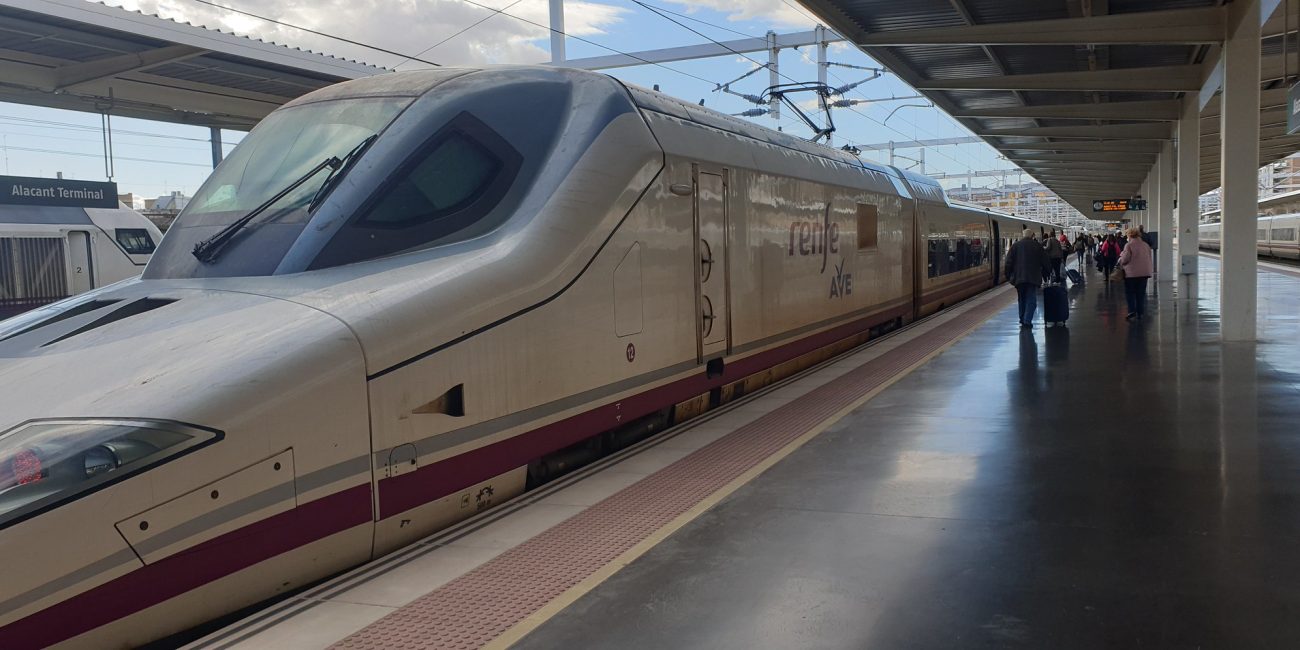
Óscar Puente said yesterday, Thursday November 20th, in Valencia that the work needed to connect the three Valencian capitals with standard gauge track will be done by 2027. This will make it possible to travel between Valencia and Alicante in less than an hour.
The Valencian Business Association put up the “I Want the Corridor” event, where Puente made this declaration. The minister said that the project is “100% planned” and that the construction has sped up, especially in the last two years. The numbers show this, since the Mediterranean Corridor has received 8.327 billion euros in investment bids from June 2018 to September 2025.

One of the most important parts of this progress is the change in gauge between Xàtiva and La Encina. This strategic move will not only cut travel time between Valencia and Alicante by a lot, but it will also make it easier to connect with southern cities like Orihuela and Elche, which are only an hour and a half away.
The minister said that having a train connection between Valencia and Alicante in less than an hour, “when it takes two hours by car,” is “the best argument in favour of rail as a future strategy.” He did, however, warn against being too hasty, saying that important issues still need to be resolved, such as making sure that trains are accessible, installing the ERTMS 2 system, and renovating the Alicante station. All of these things are necessary for the new connection to be used.
It will take two years to finish the link to the north
There is also a schedule for the train corridor to go north. Puente has promised that the change from broad gauge to standard gauge between Tarragona and Castellón will be finished in two years. This will make it possible for Valencia and Barcelona to be entirely connected by standard gauge. The double-track project between Valencia and Castellón will have moved into a new phase by then. The minister says it will be done in a couple of weeks.
Puente said, “The current state of the work is very positive,” even though a project of this size is technically difficult and has to deal with certain limits. He also said that the dates for the road closures needed to put in the new track are being set. The goal is still to finish as many duties as possible without stopping traffic, which will have the least effect on users.
The minister talked about how the corridor will help freight transport in addition to passenger links. He called it a “key element for strengthening the industrial competitiveness of the Mediterranean region.” In this regard, he emphasised the connection to the Port of Sagunto, whose construction is progressing with the aim of completion in the first quarter of 2026; the imminent commissioning of the Valencia–Fuente de San Luis logistics hub, which will be operational in less than six months; and the Almussafes bypass, also planned for 2026, which will connect the Ford plant to the rail network and, at the same time, alleviate the passage of freight trains through municipalities such as Alfafar and Sedaví, where noisy trains currently run at night.

Author: Derek Appleton

Other Articles






No Comment! Be the first one.