
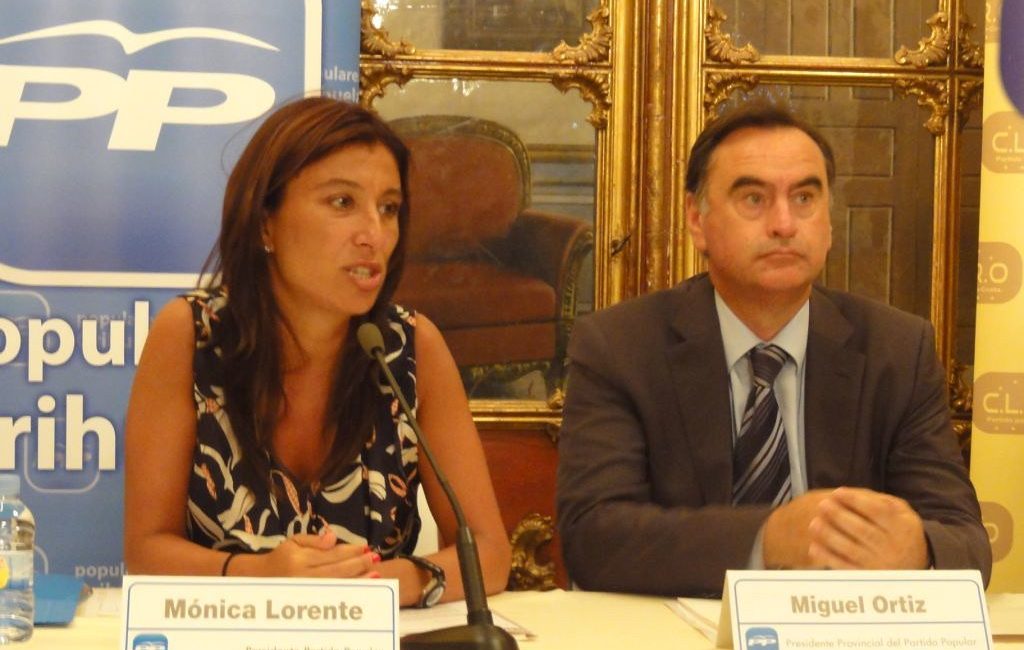
Nine of the thirty-three defendants in the main Brugal case, which tried the waste contract of the Orihuela City Council, were sentenced to prison terms ranging from four months to three years and nine months by the Provincial Court.
Judges José Teófilo Jiménez and Gracia Serrano sentenced Monica Lorente, the Mayor of this city from 2007 to 2011, to four months in prison for malfeasance in conjunction with fraud. They also sentenced then-councilors Antonio Rodríguez, Manuel Abadía, and Ginés Sánchez to four months, five months, and a year in prison, respectively.

The remaining convicted individuals include former council auditor Jose Manuel Espinosa, who received an 8-month sentence; businessman Ángel Fenoll, who owns Proambiente SL and Colsur SL, who received sentences totalling three years and nine months in prison; his son, who received a one-year sentence; and two of his associates, who received sentences of four and eight months, respectively.
José Manuel Medina, the mayor at the time, is one of those acquitted.
This is the Alicante Provincial Court’s second decision in the matter pertaining to the solid waste removal and street cleaning contract that the Orihuela City Council granted. After wiretaps and searches were ruled to be unlawful, all 34 defendants in that case were found not guilty. They included businessman đel Fenoll and some of his family members, as well as former Orihuela mayors José Manuel Medina and Mỹ Lorente, who were also PP members.
The High Court reversed the acquittal in July 2024, upheld the rejected evidence, and mandated the creation of a new sentence that took it into consideration.
Following the issue that arose because the magistrate Manel Martínez Aroca, who was the rapporteur of the first ruling, was unable to intervene in the draughting of this second one due to medical leave, José Teófilo Jiménez, the president of section VII, and his colleague Gracia Serrano took on this task.
After reviewing numerous cases, the Supreme Court ruled that the wiretaps that were agreed upon at the start of the investigation were legitimate, and the searches that the Alicante court had deemed invalid. The court also rejected the argument that the defendants were rendered defenceless by the protocol that controlled their access to the media that contained the case’s recordings.
Assistance with police work
The court observed “a lack of logical and rational basis in some of the decisions made by the sentencing court, which resulted in the exclusion of evidence presented by the Public Prosecutor’s Office, acting as guarantor of legality and the public interest, in support of its claims.” Nevertheless, it upheld the police work done during the investigation. Because of this, it believes that the prosecution’s rights to use pertinent evidence and to effective judicial protection have been infringed.
In contrast to the Anti-Corruption Prosecutor’s Office’s argument in its appeal, the Supreme Court recognised that a new trial or the intervention of a different court than the one that presided over the trial and which, ultimately, is the Court predetermined by law would not be justified because “the defendants have been tried and their respective defence strategies have been deployed.”
Although it acknowledged that “the video recording of the trial sessions and the abundant documentary support will contribute decisively to mitigating these elements,” it also considered the passage of time (the events date back more than two decades, the trial was held in 2019, and the annulled sentence was handed down in June 2020), “so the effects of immediacy may be affected.”
The facts
The defendants in the Orihuela garbage case were found guilty of fraud, abuse of power, bribery, prohibited negotiations by public officials, influence peddling, disclosure of privileged information, electoral offences, illicit association, coercion, and extortion by the Public Prosecutor’s Office and the private prosecution, acting on behalf of the Orihuela City Council, which chose not to appeal. They asked for prison terms ranging from nine months to nearly 38 years.
The events occurred between 2000 and 2008, when the Orihuela City Council, which was then under the control of the PP, awarded the waste contract to the joint venture consisting of Sufi SL, Liasur SL, and Gobancast SL. This joint venture would subsequently be known as UTE Orihuela Capital de la Vega Baja.
A Supreme Court decision is awaited on two additional Brugal pieces.
The sentencing of another of the procedures derived from Operation Brugal involves Lorente and Fenoll as well as former PP politician José Joaquín Ripoll and businessman Enrique Ortiz, among others. This case relates to alleged irregularities in the awarding of the Vega Baja waste plant.
The Anti-Corruption Prosecutor’s Office appealed the Alicante Court’s decision to acquit all of the accused, but the Supreme Court has not yet made a ruling.
The Supreme Court’s ruling in the Calp waste management case is also pending for the three people found guilty by the Alicante Provincial Court. The Zonal Plan case and this one, which is a subset of the Brugal probe, both use wiretaps and searches as investigative techniques. Next month is when the discussion and decision are expected to take place.

Author: Derek Appleton

Other Articles





No Comment! Be the first one.